Last weekend I went to Tahoe for a Belden family wedding.
It takes me some time to realize I have not been in Northern California, on my own, since 1991, with the exception of three days after Mom died, in 2014.
It takes me longer to note that I have let go or walked away from many things throughout my life. I just left them there, compartmentalized. One might argue this is how I survived my childhood, learning to do this early: to travel, to leave loved ones, to go to camp and boarding school. To do many things I was not ready to do.
As I revisit places over time, I find parts, stories, bits of me, waiting to be reclaimed.
*
Most of my childhood I lived in Santa Rosa, the same Northern California town where my dad grew up.
Born in Berkeley in 1927, Dad moved with his parents, older brother, and little sister to Sonoma County when he was three. He went to Cal for college, Hastings for law school, and then went back up north to practice law, first in the DA’s office and then in private practice where he remained until he died in 1993.
My parents met in 1955 and married in 1956; I came along thirteen years later. I was born to my parents at the ages of forty and forty-two, respectively. Outside the walls of our old Victorian, it was 1969. Inside, it was 1956, or possibly closer to the actual construction of the only house I ever called my family home.
“I had a Victorian childhood,” I told a family friend recently, and she laughed, “You sure did.”
My mother complained about our town and took me away with her on extended travels. She and I often went into San Francisco and to Modesto, where she was born and raised, and where her mother lived until she died in 1973. A little over a year later, Mother and I went to England where we wound up staying for a year, on the first trip.
Life inside our house was proper and strict. Tea time. A cocktail by Dad’s chair when he got home. Love was defined by trying to do the right thing. There were holidays, there was travel, and occasional laughter. There was abundance, in terms of space and possessions. Scarcity, in terms of any kind of certainty, particularly of my mother’s mood.
I believe both my parents wanted the surprise that I was — even if there was concern how to handle it all — but grief, death, and fear of loss were in our midst from the beginning. Prayer and superstition were my earliest inner response. I tried hard not to make the same mistakes twice. I tried not to make mistakes at all.
I was playful, creative, and curious — even sneaky, at times. I learned early, “Smile at the world and the world will smile back.” It seemed to work.
*
My first freedom came on my bicycle. I could ride to a friend’s house, or into town. With spending money from chores, I could go to a toy store at one end of town, two different gift shops, or I could ride farther toward the center, near my dad’s office.
I don’t remember ever riding my bike with the purpose of going to his office, but I vividly remember him taking me there occasionally. He let me go into the storage closet and pick either a legal or a steno pad and pen for myself. He showed me powdered milk, how the coffee maker worked, and how to pull the lever for cold water into a pointy paper cup. Then he would put his hand on my shoulder, guide me into his office, and he would work for a bit, while I would pretend to.
Down the street from his office was Corrick’s, a store that seemed to have a bit of everything, including office supplies. I learned that I could say I was Les Belden’s daughter, and the ladies would be extra friendly. This was true at some of the gift shops, too. Whenever he and I were out together, he would exchange friendly greetings with people and introduce me. We did lots of weekend projects where a more casual version of Dad came through, too. He loved the land, cattle, and going on a good drive.
*
My first memory of driving to Dad’s brother’s house — home of Uncle Charlie and his wife Jane — I think I was about five. I remember Dad parking in front. I remember all of the people. Everyone knew everyone else, except me. It was clear to me that loads of people loved these Beldens.
Later, I learned they lived just down the street from us.
Much later, during the summers, I would hop on my bike, ride to their house, and spend endless hours by their pool sunbathing and reading. Aunt Jane became a very important person in my life; at a point, she gave me a key to their house.
Charlie and Jane had four children; the eldest, Bob, was fifteen years old when I was born. Over time, I would get to know all of them, and over the years, they have invited me to many things. To my enormous regret, I found reason after reason not to go. Not for lack of desire, but for some random reason or some secret resistance or some extra effort that I seemed never to find. (In fairness, often I was living three thousand miles away, trying to raise a kid on my own. But still. Regrets. I’ve had a few.)
*
A month ago, I received an invitation to the wedding of one of Jane and Charlie’s grandchildren. I accepted.
*
On Thursday, I fly into Reno, get a rental car, and drive in the dark directly to Lake Tahoe, over Mt. Rose, at almost nine-thousand feet in elevation.
The first memory that greets me is the familiarity of these roads from the summer of 1987, just before college, visiting friends, feeling invincible. I am awed by the sheer danger of the highway and the speed I am craving, like I once did.
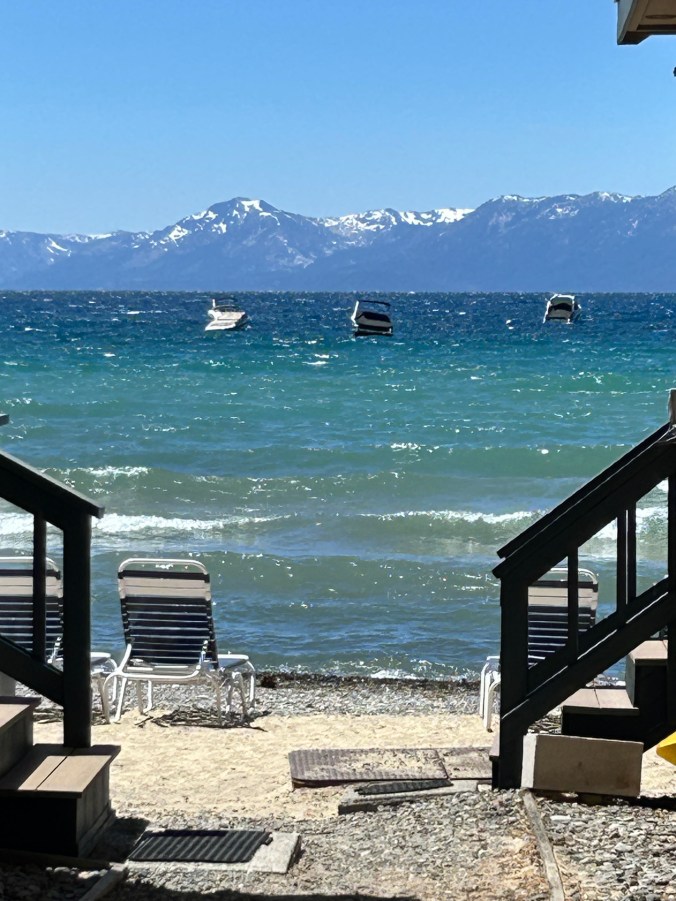
It is midnight (3 AM, my time) when I arrive at the deep, inky waters of Lake Tahoe. I need to walk to the water’s edge and take it all in. Darkness allows the stars and occasional white caps to show off. While my family never had a place in Tahoe, the air is redolent of home and history.
I shiver. It is genuinely cold, especially in contrast to the heat and humidity back east, but I don’t want to go inside yet.
I don’t know when I will pass this way again.
My cozy room has a tiny kitchen where I make hot water to steam my ears after travel. I find cream and sugar, add some hot water, and make a mini dessert.
*
Little by little, long-forgotten memories rise to the surface.
Visits to Heavenly Valley when I was tiny to see my mother’s friend, Dee. Her Westies. Her plaid trousers. Her sapphire ring (that I recently sized to fit me).
Pulling over and putting on chains. Dad telling me it was okay to eat snow, as long as it is fresh and pure white (accompanied by his laughter).
A trip with a grade-school pal to Alpine Meadows (whose mother knew my Cressey cousin, and how I loved that family association).
An adventure renting a condo with another family, where I jumped off the second story deck into the snow to prove my bravery (Dad was not amused).
White-water rafting down the Truckee River with a Belden cousin.
And Granlibakken Tennis Camp, one of my favorite summer experiences.
These scenes are before I am twelve, before boarding school. Before, for all intents and purposes, I leave home and never return, except for holidays.
*
An element emerging through Tahoe-infused memory is a sense of risk-taking. Here I am again, taking more risks. Flying in and out of Newark (recently challenged for air traffic control issues). With a blossoming ear infection (I took all the OTC meds I could, and then jumped on two flights anyway — steaming my ears during the layover in Atlanta).
By morning, I know I need to get to an Urgent Care. Which conjures another recollection: a trip to the hospital, one of those college summers. We had been driving around in a convertible; I was sitting on the back of the back seat when my friend slammed on the brakes. I flew forward and hit my forehead on the windshield.
Concussion watch through the night. Two black eyes. Sunglasses all the time. Worst of all, to me: the bruising of my ego.
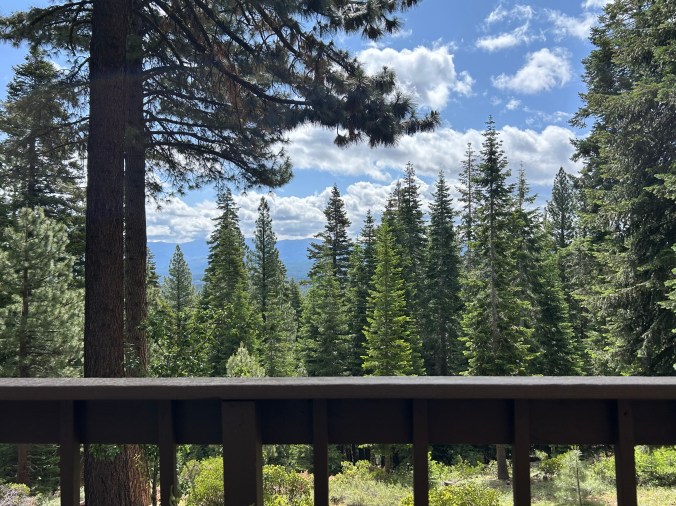
Like the brilliant blue skies and ubiquitous pines, a wild, confident, young me resides in these climes.
*
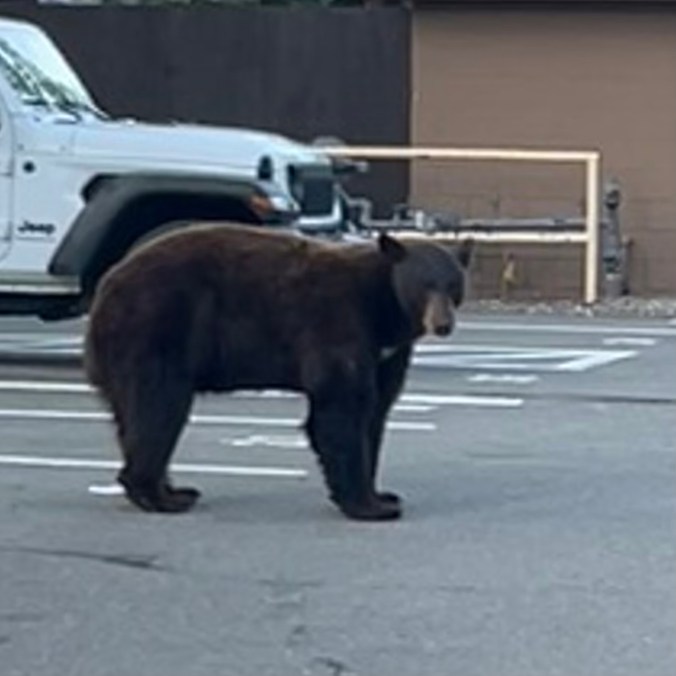
The time change works in my favor. I wake naturally for the sunrise, throw on a sweater to walk to the lake, and open the door, interrupting a black bear having a snack out of the nearby dumpster. We greet each other politely.
A few hours later, I am first in line at Tahoe Forest Urgent Care in Tahoe City, a stone’s throw from the lake. After getting my ears inspected and antibiotic eardrops, I drive California’s west shore of the lake to Granlibakken where I tour around, and then turn back and drive Nevada’s east shore to Glenbrook’s gates — picking up pieces of memory as I travel.
My ear infection keeps me from being able communicate very well; it is making the simple act of hearing difficult. I am medicating for inflammation and pressure as much as for pain that spikes, ebbs, and flows. But still, I am so glad I was brave enough to travel anyway. Had things gone differently, I might have had company on this trip. It seems better to be alone.
Over the past few years, I have gone internal, spending most of my time writing or editing and finishing up old work. A steady drum-beat in the back of my head asks questions: Who am, I? Why am I here? Where do I belong? I admit feeling sorry for myself at times that I have very few intimate connections in this life, and yet I sense myself getting closer to answers.
Eventually I turn north, away from the lake toward Truckee, to see my cousin, Bob, and his wife, Lori, who have lived there for the past fifty years. Having collected more than I expected from my past already, I turn toward one of the people on this earth closest to my dad: his nephew, Uncle Charlie’s first-born son.
*
One of the reasons I have taken this time for writing is an awareness that both of Dad’s siblings died at fifty-six, which is my next birthday, about a month away. I’ve always seen it as my first actuarial date. (My dad lived ten years longer.)
As I greet my cousin, I have a quiet moment to myself of love and loss. I still feel young. Bob already has outlived his dad by fifteen years.
We start talking right away, mainly about our dads, and it occurs to me that he knew Dad so well. But also, that as the first born of our generation, he had an experience with our grandparents, too. He didn’t know our grandfather well, but he definitely knew our English grandmother, whom he calls “Sis.”
“Everyone called her ‘Sis’,” he says.
When Bob makes me tea later, he describes being little; Charlie would drop him off at Sis’s house to serve high tea to her friends. “It felt like it was every week, although I’m sure it wasn’t. It felt like it. All of those British ladies with their accents. And the Union Jack in the house.”
Bob makes a face, as if still a kid, remembering the required servitude.
“And also, pitting cherries! All day long! For the cherry pies they made at the Sonoma County Fair. It was all part of the Episcopalian Garden,” he smiles. I picture a young Bob — a towhead like his own son (now in his twenties) — his fingers red with cherry juice, and the white-haired ladies baking nearby.
Charlie was always hard on Bob; even I knew that. His dad brooked no compromises; I think Charlie was tougher than my dad in some ways. Certainly he was a lot tougher on Bob than Dad was on me.
As we chat, Bob leans back on one of two large couches, Lori and I on the other, in front of a wood-burning stove. Bob is this marvelously familiar, weather-worn, lanky mountain man whose whole adult life has been dedicated to ski patrol, fire protection, and the U. S. Forestry Service.
The vision of him in both of these childhood scenes with our grandmother charms me to the depths of my heart.
I never met Sis, but Dad always teased me when I was in the kitchen. He would say I was just like his mom, using every bowl in the house. He would say it with such affection.
The day before Dad died, the last thing he asked for was a treat she used to make for him as a boy. Jello. I made it.
*
When I do the math, I realize that Bob was born before my parents even met. Even more shocking to me, when he was born, my dad was a mere twenty-seven.
Bob recounts when he started school there was one very old teacher who had taught Charlie and Dad, too. When this teacher looked at the roster and called out Belden, he said gruffly, “Whose kid are you? The one who shot himself in the foot?!”
Which makes us both laugh out loud.
That would be my dad. He gave me all sorts of funny explanations for what happened, including blaming his older brother. The truth: it was a hunting accident, and yes, Dad did shoot himself in the foot.
*
The stories go on, laced with the absence everyone felt when my dad passed away. Bob talks about times when he would call my dad with an issue, and Dad would say, “I’ll take care of it.” And he did. “We never heard a thing more about it.”
After Dad was gone, a few things came up in their lives where he could have helped a bunch. Bob remarks, “I remember thinking, gosh, I sure do wish Les were still here.”
Me, too, cousin. Me, too.
I hadn’t realized that my cousins might have missed him.
Bob talked about how Charlie and Dad both helped the community a great deal, in the ways that they could, rarely getting recognized for it. That was not the point. That was not how they were raised. They were both good men who did the right and just thing, like many in their Silent Generation.
A far cry from what we see heralded today.
*
I feel the need to rest a lot. It’s mainly my ears, which are totally blocked, but it could be the altitude, and all that I sense around me. Bob and Lori’s property is at 6,500 feet with a view for miles, but also with clusters of pines nearby which give a sense of protection and vision.
In a way, this is how it feels to be here, with them. I feel safe and a part of things.
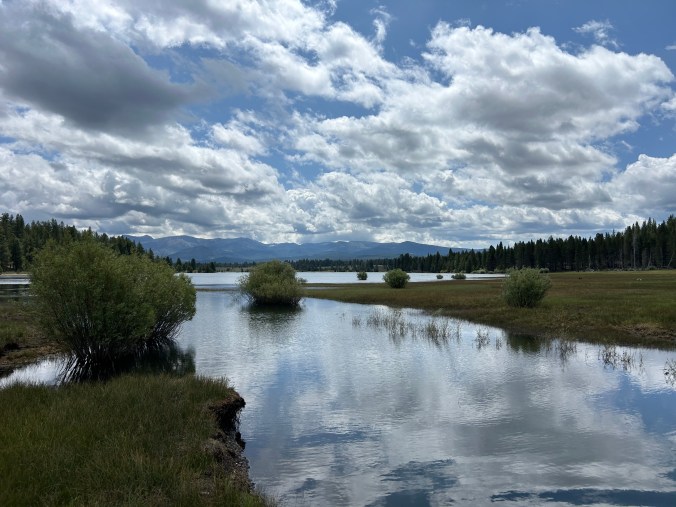
On Saturday, Bob and I go for a walk in the area where some of the Donner Party got stuck in the winter, when they got separated from the larger group. Now called Prosser Creek Reservoir, the land is flat here; the reservoir is fairly full and calm. Ornate cloud formations reflect on the waters.
We have a little bit of time before the wedding out in Blue Canyon. I decide to sit on the deck with my notebook.
Something white lands on my black shirt.
It is snow.
Followed by hail. Later there will be rain. None of this is forecast.
A sudden microburst creates thunder, 30 MPH winds, and six-to-eight foot waves on Lake Tahoe.
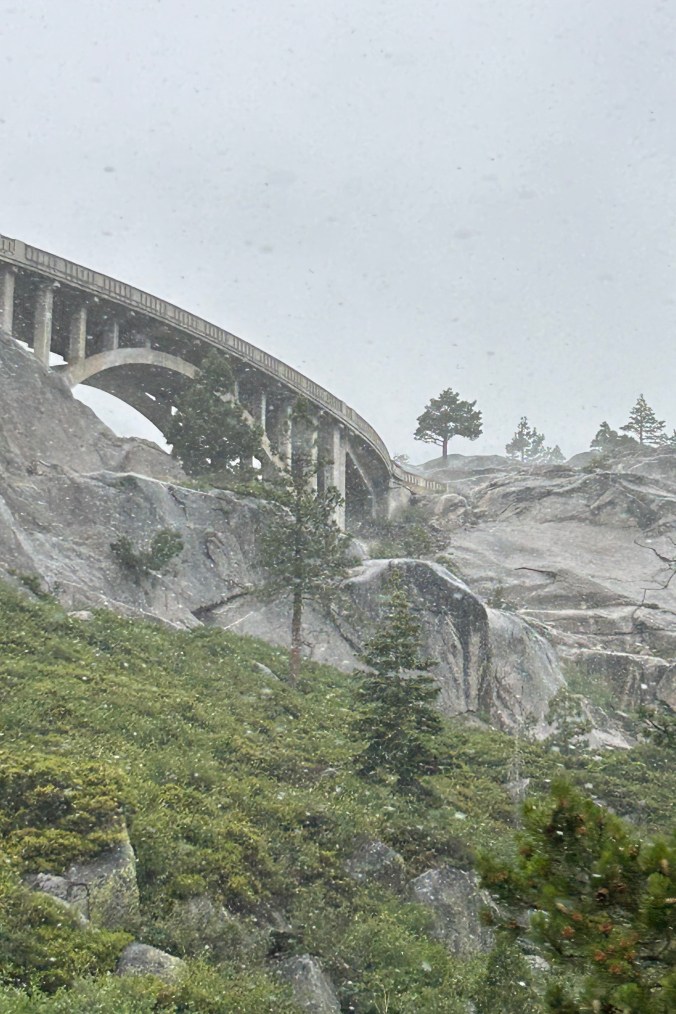
All of this continues to unfold as we drive the “old road” west, via Donner Summit, in full snow. By the time we make it to Blue Canyon, there are blue skies back at Lake Tahoe and the untouched wedding site.
What a delight it is to see all of my cousins and to meet their children for the first time! Now all in their twenties, we cluster together as a group and chat. I enjoy observing their dynamics, and love being able to say, “I’m Les Belden’s daughter,” by way of identifying myself.
I can’t help but sense Charlie, Jane, and Dad, celebrating alongside all of us.
*
The way back to Truckee is faster, via 80 instead of the old road and Donner Summit. Bob is eager to be home. I am, too. I have been pressing my right ear to access as much hearing capacity as I possibly can, doing myself no favors.
I am still glad I did it, though, as something significant begins to dawn on me.
I do indeed have living family. I am a part of this crew, even if my dad was Les, and not Charlie. No one in this group cares. I’m their cousin. This is an important, comforting reminder. I feel a little less lost in the world, and a lot more rooted to my most stable source of parental love.
Dad has been gone since 1993, while my cousins have been there all along, assuming I knew. In a way I did, and in a way, it has taken until this weekend to remember that their driveway is just a bike ride away from mine.
I am so grateful I was invited, and deeply appreciative of the people who instilled the necessary courage in me to overcome my fear of flying (even without an ear infection).
*
Sunday morning Lori encourages me to go to the Urgent Care in Truckee for something stronger than eardrops. Minutes later, I’m walking into Tahoe Forest Hospital’s facility, a few miles away. I pray for no waiting, and lo and behold, there is no one in the waiting room. The nurse tells me yesterday at the same time, about 9:15 AM, there was a two-and-a-half hour wait.
It feels like I am wearing giant headphones on my head. I can hardly hear a thing. Pressure is intense but tolerable. A nurse puts me in a room and examines me. A doctor greets me and introduces himself as he checks my chart.
“Belden,” he states.
“I’m here for Lori and Bob’s niece’s wedding,” I reply, assuming correctly that he knows them. Lori is an ER nurse.
“Well, oh well, Lori and Bob’s niece is getting married,” he chuckles, not unlike my dad, in a western, understated way. “I’ve been in Truckee for forty years, and I’ve known them for as long, I’d say. Give them my best.”
Someone else comes in and flushes out my ears. The pain is insane. I try to hold back the tears, but I cannot.
Everyone apologizes for the procedure hurting me, and I get a second round of antibiotics, oral this time. I just to need to wait for them to be filled, next-door, same building. It’s so easy this time.
Yet I am undone. By the pain. And by something else.
Maybe it’s the Belden-ness of it all. Another sense of recognition of me as someone who belongs to someone else. The assumption of my goodness by association, and the deep comfort that brings, after decades of living in places where nothing about me was taken for granted. And, dare I add, where interpretations of me have shifted along with allegiances.
Many people ask me why I moved to New Hope, and I say it’s because it’s close to my university, the only place where I feel a sense of belonging these days.
Before this weekend, I would add that both of my parents are deceased, I have no siblings, and the rest of my life is very fraught.
*
I’m only half joking when I say that when I get home, I wonder if I should move to Reno, get a job, and go to Tahoe whenever I wish.
What I might be saying is: I belong to somebody.
Which makes me think of a lyric. And of my daughter when she was little. How we used to hop on bikes together on a sunny summer morning, free as birds, singing, “Shoo fly, don’t bother me, Shoo fly, don’t bother me, Shoo fly, don’t bother me, cause I belong to somebody. I feel, I feel, I feel like a morning star. I feel, I feel, I feel like a morning star!”
You might ask: Where were we going, on bikes, so early? And I would reply: Why, we were going to the lake, of course!
To Lake Leelanau, of her childhood.
As Tahoe is the lake of mine.
*
Monday afternoon, I make my way to the Reno airport and drop off my car with plenty of extra time. I soak up the surroundings, and notice that the United Airlines area has a timeless, unchanged quality.
I say to a friend (whose parents are also of the Silent Generation), “It feels like our parents are still alive in these spaces.”
The old roads, the protection of lands and buildings around Lake Tahoe. Even some of the people. Old shirts and khakis and work boots and ruddy faces.
Sitting at the gate, I feel like Dad could walk up at any moment, and my dream of catching up to him one day would come true.
This weekend, I came close.

 Where I End & She Begins
I love you, Cressey! Your writing brought tears to my eyes. Sent from my iPhone
LikeLike
Love you right back!
Thank you so much.
I blew a kiss to all of our fun adventures, way back when!
LikeLike
Cressey…
I LOVE this entry… I know I said this before, but I will say this again… I feel as if you are talking to me. In this writing I feel all your emotions and my first thought is… you are way too hard on yourself. Just an opinion that I know is on the surface of very deep rooted emotions.
We really liked your Dad and Mom. Marie was harder to get to know but as she got older and needed more, she became warmer and approachable.
Anytime you are in Santa Rosa, know that a room and bath is always available. And I think you should think seriously about a Reno life!
Love to you… Noreen
LikeLike
Thank you, Noreen! Love you xo
LikeLike
I loved this one, C! Also having grown up on the fractured arm of a large family that, as it turns out, were all pretty close with each other but whom we almost never saw, the section where you realized your uncle and aunt lived down the road from you especially resonated with me. xoxo
LikeLike
Thank you, Liza. I love hearing when things resonate. Thank you for being such a loyal reader and friend. It means so much to me. xo
LikeLike