“What hempen home-spuns have we swaggering here,
So near the cradle of the fairy queen?
What, a play toward! I’ll be an auditor;
An actor too, perhaps, if I see cause.”
– William Shakespeare, A Midsummer Night’s Dream
An auditor myself by day, this Sunday mid-morning, I drive to campus, to Woolworth Center, to try on VR glasses for the first time. The occasion is Future Presence: Mahler Chamber Orchestra in Virtual Reality and Spatial Sound, featuring selections from Felix Mendelssohn’s A Midsummer Night’s Dream.
Puck may well be in my midst from the start. I am a few minutes early, and the doors are locked. Never a cause for complaint, having extra time on campus I walk around the new art museum, get a glorious view of Nassau Hall in the morning sun, spot two tigers, one in shade and one in light and return to Woolworth. The music department. The place where I once spent much time, largely meeting (or waiting for) X. Remodeled since the 1990s, it still resembles itself. I walk in, for the second time in almost thirty-five years.
*
My maternal grandmother was a concert pianist. When I was small, she was very near the end of her life, at times not knowing who I was, but she did ask my mother, “Does she have the music?”
Reader, I must report two things: I did not. And: my mother did everything in her power, from carrot to stick, to put it in me.
I played piano from age three through eighteen, clarinet, plus some guitar, violin and cello on the side from age ten to thirteen. I had practice hours at school and at home. My playtime was contingent on having practiced both my scales and arpeggios and whatever I was assigned. My parents supported my music and did everything to make me feel good about it, but it always felt like a chore to me. One in which I came up forever short and annoyed at myself.
Today, I cannot play a note of anything, really. I can read treble clef and roughly sound out a part. That is all.
*
At 21, I got engaged to X, a music major. Trained in piano, cello and bass, his degree was in composition and performance. Once married, we had a short stint away from music, but by the time we were 23, he was working in the film music business, and music was a part of our everything. There were times when I went to sleep listening to him work on a scene and woke up to the same sound, sometimes even the same scene. We would joke about it. The most memorable: Rick Moranis in Big Bully saying, “Don’t touch that moon rock!” I can still hear that line, on repeat. X’s first real Hollywood cue.
I can say, “Don’t touch that moon rock” to this day and make him laugh. Sometimes.
Near the beginning, X had a part-time job helping to operate an Auricle Time Processor, a computer system that put a click/beat into the ear of each orchestral musician recording a film score. He was on numerous scoring stages, in a sea of musicians, on call, making live changes when the composer or conductor made adjustments. Time was money. It was stressful work. He always came home with stories.
Later, I worked for him as a copyist, printing and taping scores together for his first composing job.
When I heard his stories and taped together parts, I created characters for the various instruments, like they were people themselves, which in a way, they were. Orchestration, a conversation between them. Often a conversation I often did not understand very well.
“Love can transpose to form and dignity:
Love looks not with the eyes, but with the mind;
And therefore is wing’d Cupid painted blind.”
(Scene 1, Act 1)
Reader, as you may already know, our love does not last.
For me, music was never meant to be. But today I realize just how much it is a part of my story.
These flashbacks surprise me, arising lately with such profusion. Perhaps it is the fires, burning where we once loved one another. Destroying the whole neighborhood, despite its bedrock foundation and surety to withstand most earthquakes. Unprepared for fire. Not unlike us.
(During that fateful Northridge earthquake in 1994, X put one arm around me and the other arm around his tall rack of music gear. We all tried to get under the doorjamb.)
“Are you sure that we are awake?
It seems to me
That yet we sleep, we dream.”
(Act 4, Scene 1)
*
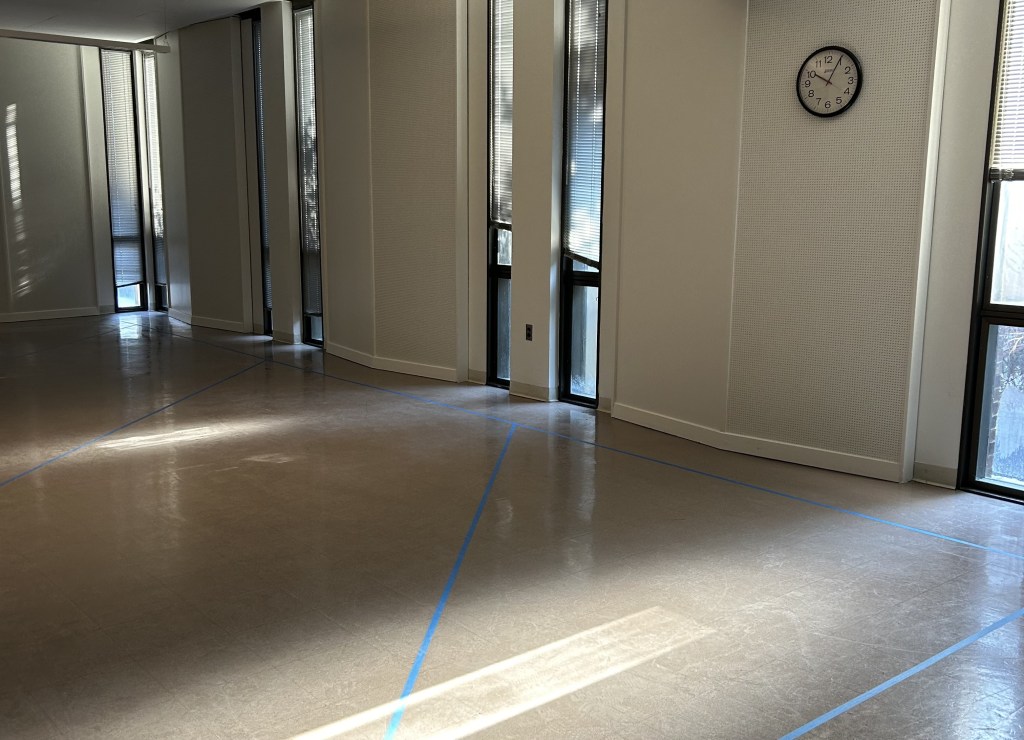
Back in the Puckish present, I walk into Woolworth for the second time in almost thirty-five years, check in and watch a short video in preparation for the VR glasses and the concert ahead. Then I am taken with two other attendees into a classroom, seemingly empty but for a table of tech. The other two people get fitted first, and from my vantage point, they stand about aimlessly. I can hear Mendelssohn escape faintly from their headphones.
My guide into the classroom asks if I have ever put on VR glasses. When I say no, she says that this is a first for many attendees, “a lovely entry point to virtual reality,” she adds.
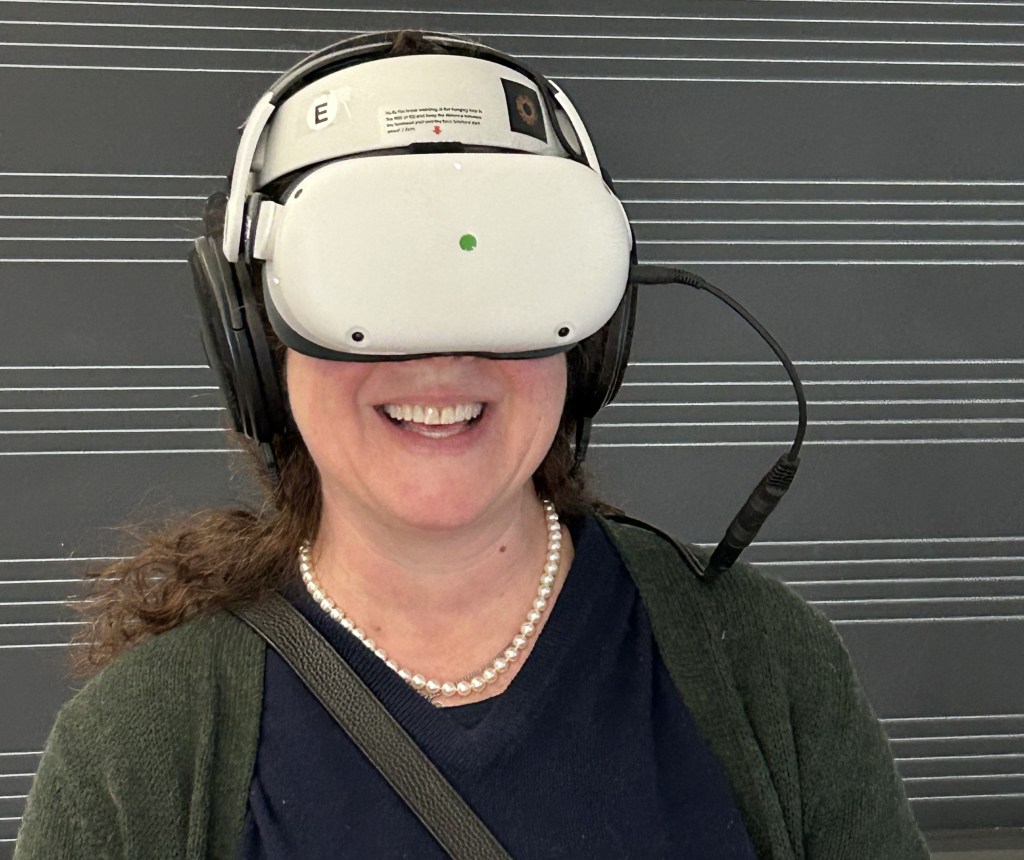
When it is my turn, I ask for a photo: my first time experiencing one reality behind glasses, and nothingness in front of them. I am a little bit nervous.
My guide has prepared me well, including noting that the orchestra will appear very pixelated. And then there they are. Playing. Forty-eight musicians, before me, and yet not. Fantasy and reality at once. Strings, brass, woodwinds, perc. Like Puck or any fairy, I can walk among them. Getting close to each instrument offers clearer reception of that individual sound.
“Mine ear is much enamored of thy note;
So is mine eye enthralled to thy shape.”
(Act 3, Scene 1)
At the start of each movement, segments of Shakespeare are projected at eye level. Above, millions of what look like fairy lights form an impression of trees in a forest under a night’s sky.
*
Later I wonder if I am flooded with flashbacks partly because this is such a new experience.
All of a sudden, I feel kinship with the clarinetists. I recall orchestra camp, seventh grade summer. Never being able to hear my part, sitting in my section, clueless, then realizing that even if I played a wrong note, no one would know. Being a part of a musical group was new to me. Every mistake I made in piano was painful and obvious. Every concert, torture.
Walking around, I hear a familiar tone in the lower octaves. Why such familiarity, such a draw to my spirit? To get to it, I walk by a solo flute. Puck, personified.
I remember that my mother once played flute when she was in school. I never once heard her play, but as a child, in my reluctance to practice piano, I would sneak and open her black case and admire its silver shape, lying in blue velvet. Much of my mother was someone I never met.
Behind the flautist is the sound I seek. The French horn. Of course. A thought, long forgotten, returns: how much X admired the French horn. Person or player or skill or part? I never did fully understand, but one always is curious about what one’s love loves.
I walk across the room to the percussion section and hit the reality wall. Half in, half out. Dodging the shape of another participant, I step in and stand behind all of the instruments, appreciating this rare view. I find myself hanging out with my tones, the clarinets, and think of how my child, too, played its dulcet voice for a few seasons.
I am alternately swept away and caught up in mind and memory. The experience is intimately human, standing before a musician as they change reeds or switch instruments or wait their turn or turn a page. And then it is infinitely surreal getting up close to a player—violating what would be their personal space under any circumstance—imagining touching one, wanting to look into their eyes. Missing both. Belatedly realizing that I am closer than I would ever get to be. Ever.
The fourth and final section is the “Wedding March.” A perfect high note. As it crescendoes, I wish had the whole room to myself to dance and weave in and around the orchestra. I want everyone to wake up from this dream and embrace the one they love.
“The course of true love never did run smooth.”
(Act 1, Scene 1)
*
Glasses off, I am back in an empty classroom. Amazed.
As with all good things, I do not want to leave. I want to engage. I ask about the sections of Shakespeare and am given a collection of short essays about the piece, the performance, the play. The creator, Henrik Oppermann comes up to me. Having no idea who he is, I share a capsule of all these thoughts. The past, present and future. We talk about how these glasses almost force the present tense. As if they could be a form of meditation? I ask, and say: I think next I’m going to the Apple store. I’m curious now.
And he says, Come with me.
He gets a different set of glasses and asks someone to unlock a different classroom. He sets up the glasses with gestures I will recognize when I get to Apple. A new vernacular of swiping and clicking. Placing the glasses on my head, I can still see him, but I also see a virtual string quartet in front of me. Again, deliberately, creatively pixelated. No additional headphones like earlier, but the sound is extraordinary. Get close to the cello, he says. I do. I kneel as if the instrument is a pregnant woman, and I want to feel the baby. I sense the vibrations of the instrument, if that is even possible.
Yet my sense of touch feels challenged. I harbor some awareness that I cannot reach anything. I cannot engage wholly. Increasingly I feel this desire for someone to hold me, to reassure me somehow, of my existence in bodily form. It fascinates me that our brains have not evolved much over time. I feel mine doing somersaults, trying to understand. I feel slightly lightheaded.
*
A few months ago, I was told to go to the Apple store to get a demo of the Apple Vision Pro VR glasses. I decide that today is the day.
Fifteen minutes from campus, I arrive just before noon. It is not busy. I am assigned a genius, and he sets me up for a twenty-minute demonstration. He asks if I am phobic or triggered by anything. If I have special likes or dislikes.
Nature, yes. Violence, no. Happiness, yes. Pain and fear, no.
He takes a phone and scans my face up and down, right and left. I have just given Apple my password, haven’t I?
Glasses on, I see a birthday party with a cake appearing directly in front of me. A man leaps the fourth wall into my face. I watch an underwater scene from Avatar, and a woman hair-raisingly tightrope over a canyon. I see Joshua Tree, Yosemite and Mount Hood. I see elephants and rhinos. And I see a special music video by the Weeknd, which looks like a near-death experience, not a good one.
One of the things I find is the consequence of not having a constant gaze. I’m often off, exploring visually, even it if looks like I am paying attention. Having small eyes, squinting in bright light, and wearing sunglasses have kept this under wraps until the VR interface. It takes me more than a minute to realize the cursor is my eye.
My inner Puckish self loves to gallivant. Busted.
I sit on the beach in Bora Bora. This is what I came for. This is what I have always believed could be curative. The palm trees move slightly. The view is total. I would like to stay here and calm, but we go back in for one last tour of the greatest hits and end with dinosaurs, which have never fascinated me. But that’s okay. By now, I am ready for old-fashioned reality.
I take off the glasses, find out the price tag, and try to regain my footing.
Like other adventures when I dare myself, I am glad I’ve done it. I’m also glad I’m done, and I want to go home to think about it. My desire to be held and reassured of my existence in bodily form is greater than ever. My brain feels like someone toyed with it, and it is now chewing hard on what is real and true and right and just for entertainment. Fantasy became, for a few moments, inseparable from reality. My ability to sense and protect myself, in jeopardy. My brain couldn’t tell the difference.
I feel nauseous. I need fresh air. I reach out to a friend, drive home and go for a walk.
*
Professor Nigel Smith notes that A Midsummer Night’s Dream invites “all of the characters… to enter the realm of the imagination, and respect it, use it to their best advantage, even if it involves a deception, as they go into the future… The play suggests, is there any difference between illusion and reality, and are they in fact two sides of the same coin?”
The artistic lead for Future Presence, Tim Summers, says, “VR space is a theatre for sound.” He is also a violinist for the Mahler Chamber Orchestra, and may have made one of the best points of all when he correlates the donkey’s head on Oberon to the VR glasses on us. The joke is on whom?
It is striking to add to the mix that Midsummer was written in 1594, when Shakespeare was about thirty, while Mendelssohn composed part of his piece when he was eighteen, in 1826. Where will today’s art be in as many years? And how will it be consumed?
I want to talk this through, in depth, and I try. My life is about digging, diving, touching, looking and caring about divining some sort of truth; what I say is, “Isn’t life more of a fascination without VR?”
Later, I read more of Summers and cannot disagree: “We need only look at a subway full of people immersed in their telephones, to see that the borders between virtual and actual reality are not only porous but full of holes.”
*
What I realize as I step back is how, when I am happy, I want less fantasy, not more. If I am content, I put away the phone, the television, the films. I want to touch. I want to engage my eyes with truth. I want to see and be seen.
At this point in mid-life, there is so much in us that creates our history. I feel myself becoming my own virtual reality. Depending on the input, I find an association: My eyes flicker from fire to family, from concert to classroom, from instrument to childhood.
One of my struggles lately has been my sense of lack, in terms of immediate connection with my closest people. Leaving campus today, after my extra preview of the string quartet, I conclude that I have created a proxy, a surrogacy, for family connection in several forms including our shared university and my written word. Together they invite me into discovery and allow me to retreat later into safety to appreciate what I have discovered. I dare myself to keep auditing, to advance bravely and to reap the spoils when I get home.
With an event and adventure like this, followed by an afternoon and evening with articles, books and music to make sense of it all, I am at play. In the virtual reality of me. (Apple can keep their glasses.)
“Lord, what fools these mortals be!”
(Act 1, Scene 1)



“A solo flute. Puck personified.” You do have the music in you. It’s in the very cadnece of your prose.
LikeLike
*cadence.
LikeLike
Oh, thank you, Zellie! What a lovely thing to say. Thank you for reading. xox
LikeLike
Love this piece! Your description of feeling untethered by the VR was so evocative, and the Puck parallels were great.
LikeLike
Thank you, Liza! xo
LikeLike