“Grace is not part of consciousness;
it is the amount of light in our souls, not knowledge nor reason.”
– Pope Francis
This morning I rise with the sun, put on a blue skirt, sweater and coat, hop on my bike and ride across the bridge for a holy day of obligation: the Feast of the Immaculate Conception. Noted in my calendar for the past four years, the significance of this day runs deep.
When my daughter, G, was looking for space to practice her art, she found a building that was once a church dedicated to Mary. It was called the Church of the Immaculate Conception, located in an Appalachian county in Eastern Ohio. G moved during the pandemic and began work on the property immediately. I came along for the first two years.
Long de-consecrated, the church was a fascination to me. One of my early jobs was to open it to former parishioners. I had to prepare them. It will not look like the church you remember.
It was hard for many to see the decayed plaster, exposed rafters and giant stains left by leaks; entropy, winning. The spirit of the place lived on in their minds, certainly not what the fresh eye could see. Later I will learn that this is true of the whole town. Giving directions, they still say: “turn at the barber, then over by the market,” or reference the oak cabinets at the jewelry store. None of these places remain. (I was there when they demolished the jewelry store with a tractor to spare it imploding and hurting someone. Weeds were growing inside it. The roof, long gone.)
To anyone who wished to accept, we offered the chance to pick up the brass plaques engraved with their families’ names for erstwhile donations, or to take a pew, if they could get it out. The slow and careful removal and donation of larger things in the church fell to me, too. I found another church in Moon Township, PA to take the organ; a faith group to take the sound and bell system; a local theatre to take the pews; a local business to take the altar and light fixtures; and a local family who lost their sister to the 9/11 attack to receive a few stained glass windows that were independent of the structure. We received little to nothing in return.
What was left was five thousand empty square feet. The shell of the structure plus its windows. We used a grinder, throwing sparks when we shaved down bolts once holding the pews in place, and we found giant metal shelves from an old dairy to begin to make the space functional as a studio. In exchange for the light fixtures and altar, the local businessman/restorer put in light plugs and provided a few super-bright LED work lamps.
A transformation was under way. But what stood then, on day one, and what stands now, are all of the stained glass windows that make the place. They are big and grand, largely blue. Very Marian, I’ve come to learn. At the beginning, I wrote, “Mary stands, tall and proud, in the perfectly preserved stained glass windows… deconsecrated or not, Mary stands.”
*
The growth curve for Wellsville, Ohio has a “height” pin at 1920, declining ever since. A village left behind by globalization and consolidation of industry, much of the past lingers like the barges of coal that still travel up and down the river every day. Population 3,000; poverty rate 35%, it is a place where the county, if not the state, sends its most needy. At the same time, it was once glorious, which can be seen in the architecture, protected for decades by layers of lead-based paint. A great preserver, lead.
Families also preserve the place. Many have stayed because this is home; some have never been to Pennsylvania, which is only forty-five minutes away. Almost everyone knows everyone else or knows someone who does. There is one school. People greet each other by high school year or as someone’s brother or sister. This was profound to G and me, especially since neither of us have siblings. I never had grandparents either; she still had two (until very recently—neither one related to me), but they were far away. Where we came from last, in New England, she was asked why she lived with her mother; here, people wondered where her people were. Just one parent with you? Just you? Why? Everyone in this village is a part of a group bigger than themselves, and if something goes wrong, as it often does, they call a member of their family first.
This was never my experience. I left home at fourteen. My parents had me late in life, and both have been gone for a long time. My child is my only kin.
Within weeks of our arrival in Ohio, the summer of 2020, my daughter joined the fire department. She went on to get her emergency medical responder certification, too. At a point she ran for two departments; she felt like she found her crew in the local one. Often she worked alone, long hours, particularly during the pandemic, and she answered dispatch for the police, imperfectly at first, but she is a quick study.
The last call she answers will be the East Palestine Train Derailment; her crew, among the first responders.
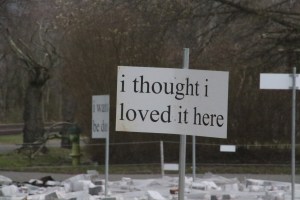
She helped save countless buildings, the lives of many people and some animals, mourning quietly when their efforts were in vain. She dated a fellow fire fighter and had some of the happiest times of her life during this time. Later she will make a sign that says: “I thought I loved it here.” There will be many signs.
*
Boosted by this confidence and having learned about the structure of buildings from fire fighting, G mixes in her knowledge of partner dancing and discovers she can lift things far beyond her weight. Ergo, she can take down buildings, one piece at a time, with a NY hook and careful thought.
G is an artist, a sculptor. This has always been true. This is what she is there to do. When we arrived, we met with the first mayor (there have been three since 2020) to share some of her ideas and see if there was a sense of welcome.
G likes to work with found materials and creates elaborate rules for her work. She is drawn to beauty through her own eye. She sees beauty everywhere in Wellsville.
She sees beauty in old, fraying structures and in burnt wood. She tells me she wants to take down all of the buildings in the village that have fire damage. This is not the first time she has told me something outlandish; I am never prepared. How in the world will you do that? I ask.
Together we reach out to the Land Bank. They say no. She speaks to her pals at the fire department and asks around. You just need one job, I tell her; once you’ve done one, you can get hired again. (I remember giving the same advice to her dad, in Hollywood, long, long ago. You have to prove it to do it; once you’ve done it, you’ve proven it. Plus ça change.)
Somehow G gets the names of the owners of the fire-damaged houses, and she reaches out to each one. Her first job winds up being the lot next to ours. Not fire-damaged, but in bad shape. On Main Street, people drive by and watch her, a marvel: “Who is that girl, taking down that whole house by herself?”
And then, ta da, she is proven. She works tirelessly and leaves each lot pristine. She gets paid in the wood she recovers—of great value to her—and gets reimbursed for renting the dumpsters she fills.
Six houses and one porch later, she has all of the materials she needs. She builds a lean-to and stores all of the wood she has collected, as her wheels begin to turn on how her piece will actualize. She follows an inner voice that is not always loving and kind. (We will see this in the signs.)
Taking down the blighted buildings, she is nothing short of a local hero. At the DQ, at the mechanic. They all know her. She is loved.
*
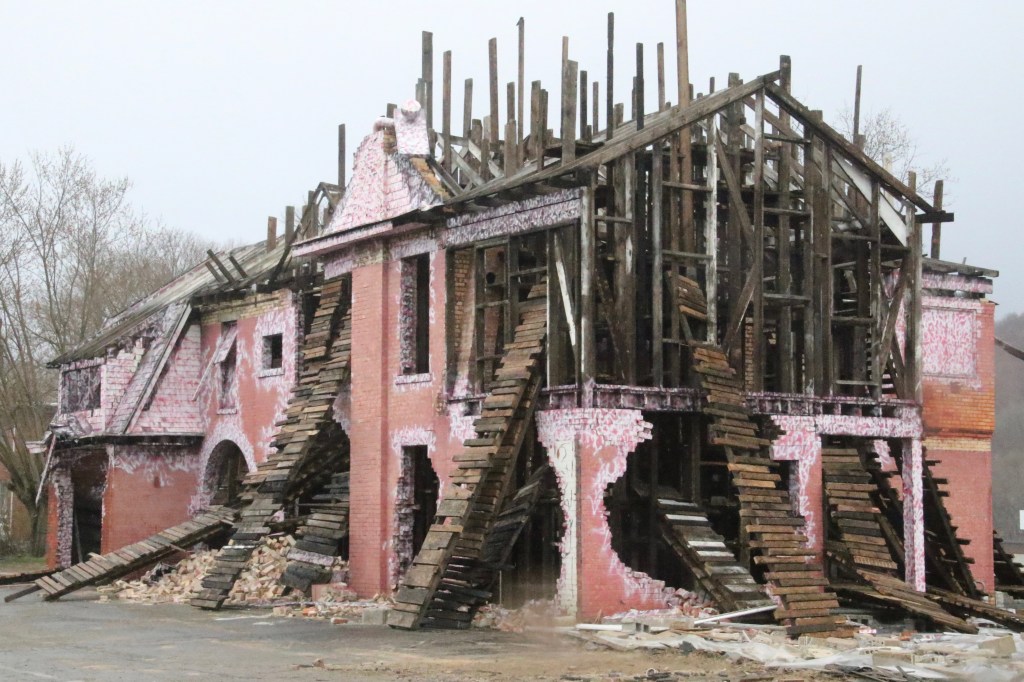
Slowly she begins sculpting a building on the property, the former rectory. Rotten from the inside out from disrepair and neglect, this is one of the many places people see through the rheumy eyes of remembered grandeur. Suffice it to say, I recoiled when I went into it the first time. Someone nearly fell through the second floor. It was already a legal nuisance. The entire property was, arguably the church least of all.
To G, it looks like an opportunity. But as soon as she begins her work in earnest, to many former parishioners, her actions look like a defacing.
A defacing of the illusion in their minds’ eye of what it used to be.
As she sculpts a full-scale piece reminiscent of a three-dimensional Escher drawing, no one understands or even tries.
Following mathematical rules she creates, she builds an interior structure of paths leading to other pathways, and she hoists beams high into the sky—all the while battling to hear her own central command and attempting to ignore a steady shift in public opinion against her.
Light turns to shadow. By this point I have moved away. She reaches out for help to several of us, but our replies do not connect or relieve the pain base from which she is calling. We make things worse.
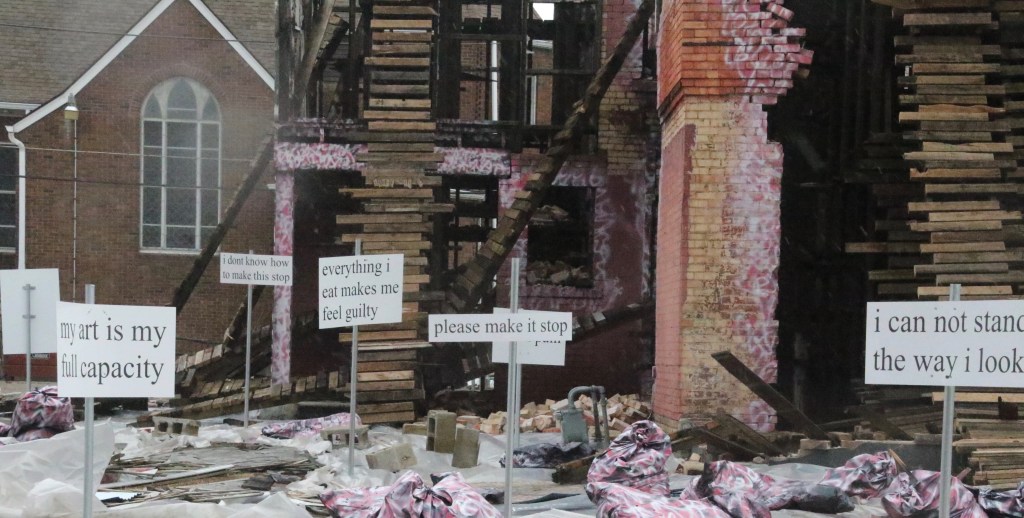
As the giant sculpture takes form, the critics get louder. She realizes no one understands her and begins to write, creating signs that become part of the piece. An attempt to speak from her source, to explain, to reach the unreachable.
She calls the whole sculpture: But I Misunderstood: Six Houses & A Porch.
Once complete, her work becomes piercingly polarizing. People come from far and near to scorn or revere. Discovered by a professor at Berkeley on a Guggenheim fellowship, she gets a sip of oxygen which helps her continue; written up meaningfully and at length by the Cleveland Plain Dealer, she stands tall, but barely, tipping over later in despair. In darkness, she applies to graduate school, having no idea how she will have the energy or courage to go if she gets in.
People knock on her door to say that her work changed their lives; they feel like she can see inside their brains or their private diaries. Some bring friends, or parents, or daughters. Many understand.
The attacks from the villagers become more virulent, and her inner attacks follow suit. As without, so within. She adds more signs.
How am I? She asks rhetorically and answers: check the signs.
The pain radiating off the signs makes it hard for me to look at them. When I look, I find it hard to breathe. I feel the same way when I see my child being slandered on all of the village Facebook pages. When the mayor calls. When the mayor’s wife comes by. When I meet with many of the most hurtful voices, under different a guise, in my role on the Community Foundation of which I am a founding trustee. I continue my support, helping the town. When I write a letter to my fellow trustees, I receive no reply.
One local friend brings her friends. She brings every single person who visits her. She speaks proudly of G’s work and her role in the community. She tells the Cleveland Plain Dealer that G’s work should stand. People should come. It is art. She understands.
*
More press. More coverage. More slander.
*
A mere sliver of herself, G gets into graduate school. She doesn’t know how she’s going to do it, but she doesn’t know what else to do. She is living in the nunnery that I renovated, originally thinking I would live there. For a long while she has been holed up in one room, awake at night when no one can see her, sleeping during the day when no one can hurt her. She has put up Mylar on the windows, reflecting the village back on itself and isolating herself further. Doing everything in her power to save her own life, even if it means hurting herself more on the inside.
I worry all the time, powerless to make a difference. I respond to the few who reach out. Most do not. I visit G regularly and try to help where I can. My energy gets siphoned to no avail.
I continue to show up for meetings and advocate for what is best for the community. A buddy calls to ask about the future of the nunnery; he knows someone who needs a home. In many ways, this is what we need: not enough time to think. I get in the car while still on the phone with him. G and I pack up her things, and the tenants move in by the end of that week.
Since G will be in Rhode Island in the fall, we find her a room in June, and move her in. It’s a much smaller space, but it’s new to her. We are hopeful.
*
Before things turn sour with the village, I start going to church again on Sundays. As things get worse, I dip more and more into prayer. Ever a salve, it becomes more of a nourishment, a requirement, a way to calm my wrecked nervous system.
One day I walk into Mass in the middle of the week. It feels so comfortable that I begin to attend those quiet, small, short services regularly. After Wednesday morning’s services, there is a separate prayer for healing with a recitation, “Mary, Mother of Sorrows, a sword of suffering would pierce your heart; bring comfort and hope to all mothers who suffer over their children.”
When I was little, I learned Hail Mary in French. I dust it off and recite it often. Priez pour nous. Pray for us.
A friend gives me a Miraculous Medal; I wear it constantly.
Every time I go to Wellsville, I visit Mary Who Stands, in G’s studio. She is as tall as some buildings. Sometimes I sing.
*
After moving to Rhode Island, G goes back to the Village often; sometimes I come with her. She prefers to work in her studio, with all of its space and freedom. She still thinks she loves it there.
Part of her graduate study involves presenting her body of work. She shows images and speaks of But I Misunderstood. And it is understood.
She grows a little bit stronger.
*
One day she opens the main door of her Rhode Island apartment building and sees a sticker for registered mail delivery in her name. She takes a photo of it and texts me.
The village wants But I Misunderstood taken down. It is a public nuisance.
She has a panic attack. She hurts herself more.
Crawling over the finish line of her first semester, what emerges is a startling amount of acceptance and a vision.
Acceptance: But I Misunderstood, the building-sized sculpture, may need to come down or be revisited. She will try to do it herself.
Vision: to create an art residency out of the property. A program that will bring artists into the area for time and space to create; a program that will keep bringing art into the village, in perpetuity. Wellsville Art Residency Program.
G and I play with these first ideas over the weekend while I try to hide my awe—if that is the word—for her desire to go back, to make good, to mend fences—or perhaps to prove her point.
For what it’s worth, I am not pushing her. In her shoes, I would never have been able to handle such resistance. I would have taken my ball and gone home, a long time ago.
*
This year, the Feast of the Immaculate Conception is recognized on Monday since the actual day, December 8, falls on Sunday. In our parish, Masses for holy days of obligation are at 7AM and 7PM, essentially the starting and the ending of the light. I am ever drawn to dawn for prayer, for the listening and chance at clarity.
One of the things G often says is, “I want clarity.” She wants her reception to be clear. Many of us have muddied her signal, myself included. I used to believe mastery was achievable in motherhood; today I feel tender toward myself for such faith.
All day I hold Mary close to my heart, unable to imagine what it must have been, to be His mother.
The most common prayer to Mary begins, “Hail Mary, full of grace.” This morning, Father Alex says “full of grace” means “full of God.” When I learn that Pope Francis calls grace “the amount of light in our souls,” I consider: Perhaps motherhood is simply all about boosting the light as best we can.
Evening beckons. I pray for grace as far and as wide as it can go.
~
 Where I End & She Begins
So utterly beautiful.
LikeLike
Thank you! xo
LikeLike