A baby sock. A baby bottle nipple. Poker chips. A domino. A yellow “Sorry” piece. Dice. A container of red glitter. Marbles. Broken glass.
Even when I thought the area around the convent was cleaned up, I would find another piece of broken glass. And another marble. One made me fear for bare feet and future gardener’s fingertips. The other made me curious: marbles? I put every marble in my pocket and carried it back to the rental apartment. I love marbles.
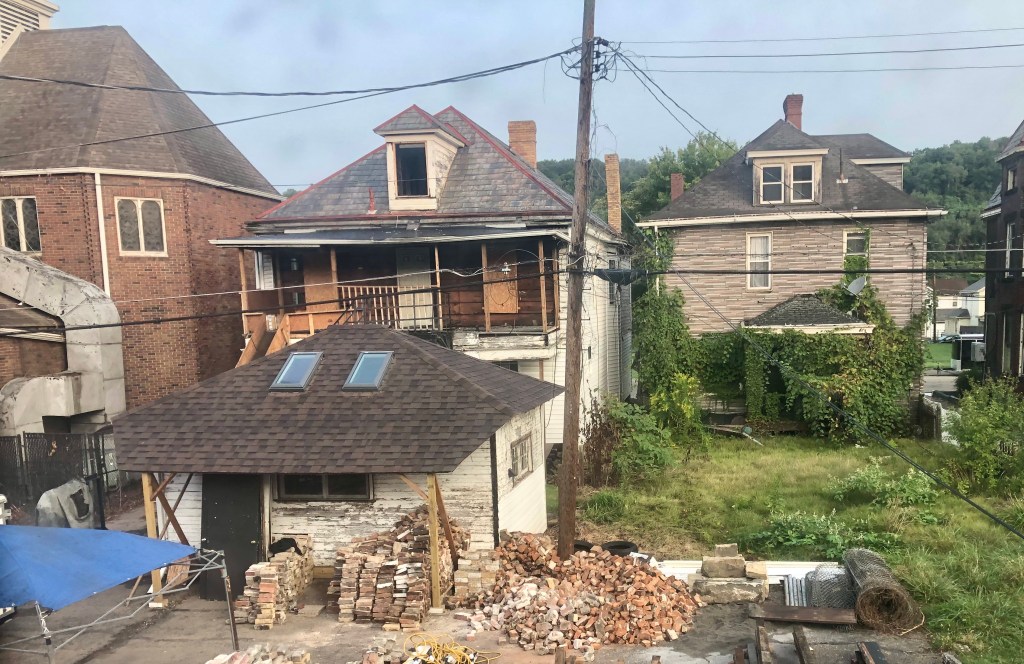
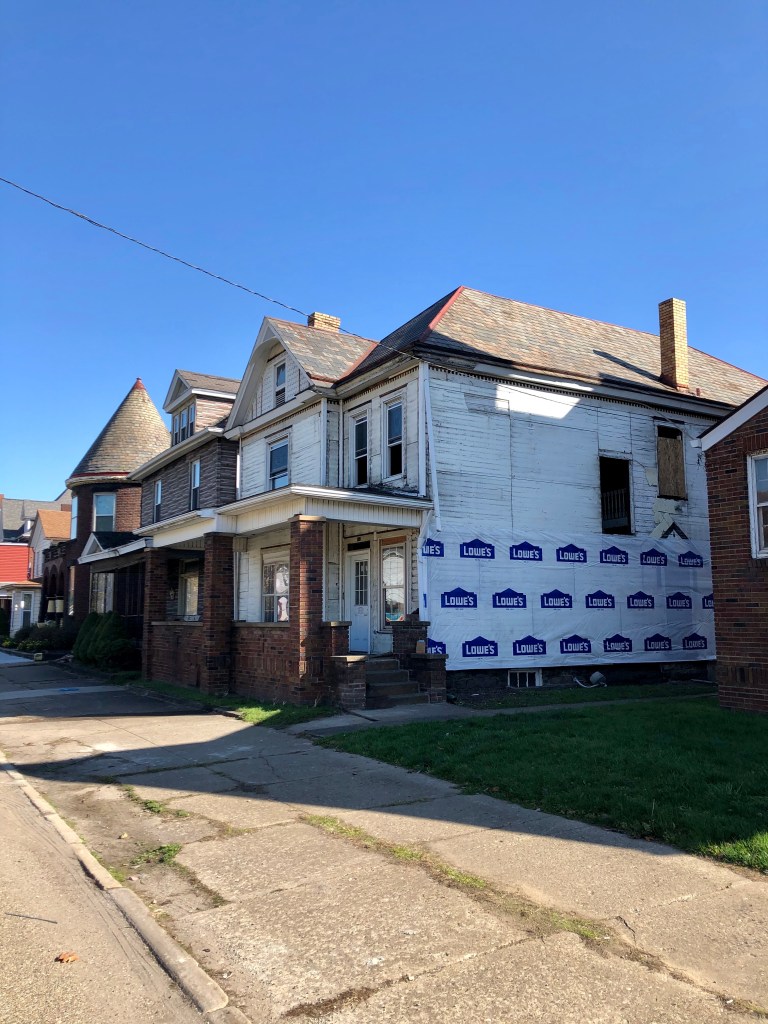
When we purchased the formerly Catholic property, three buildings were sold as a lot, what was once a church, a rectory and a convent. The latter had a sticker on the front door indicating that it was not to be inhabited until the lead paint therein was abated. The exact words were in bold red caps, “WARNING: ORDER TO VACATE.” And in smaller but still black bold, “This property contains lead hazards and has been declared unsafe for human occupation especially for children under six years of age and pregnant women as ordered by the Director of the Ohio Department of Health.” And in smaller red bold, “Removal of this sign is punishable by a fine and/or imprisonment. Each day of violation is a separate offense.”
On the July 4th weekend of 2020, G and I drove to Ohio from Massachusetts; her dad, from Michigan. We met in the middle, eight hours of driving each. We anticipated spending one night, but it became a weekend. Assessing the property for possible purchase, our eyes were on the church and the river and the rectory. The convent was an afterthought, and in the sale packet, the previous owner included a bid for its demolition.
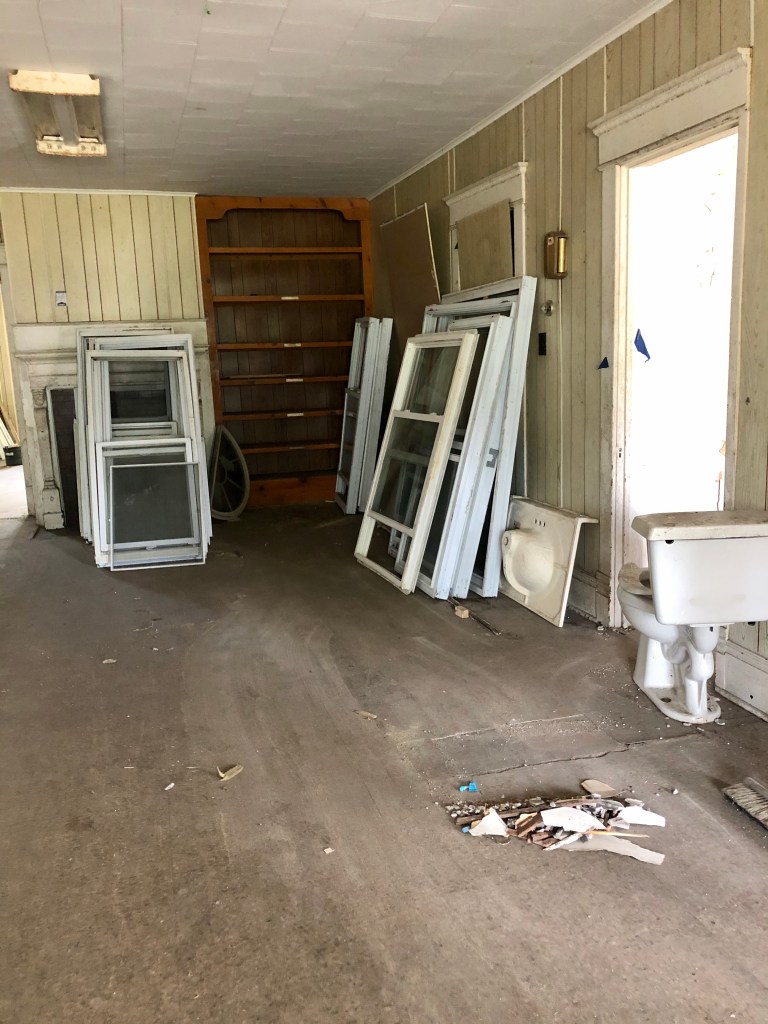
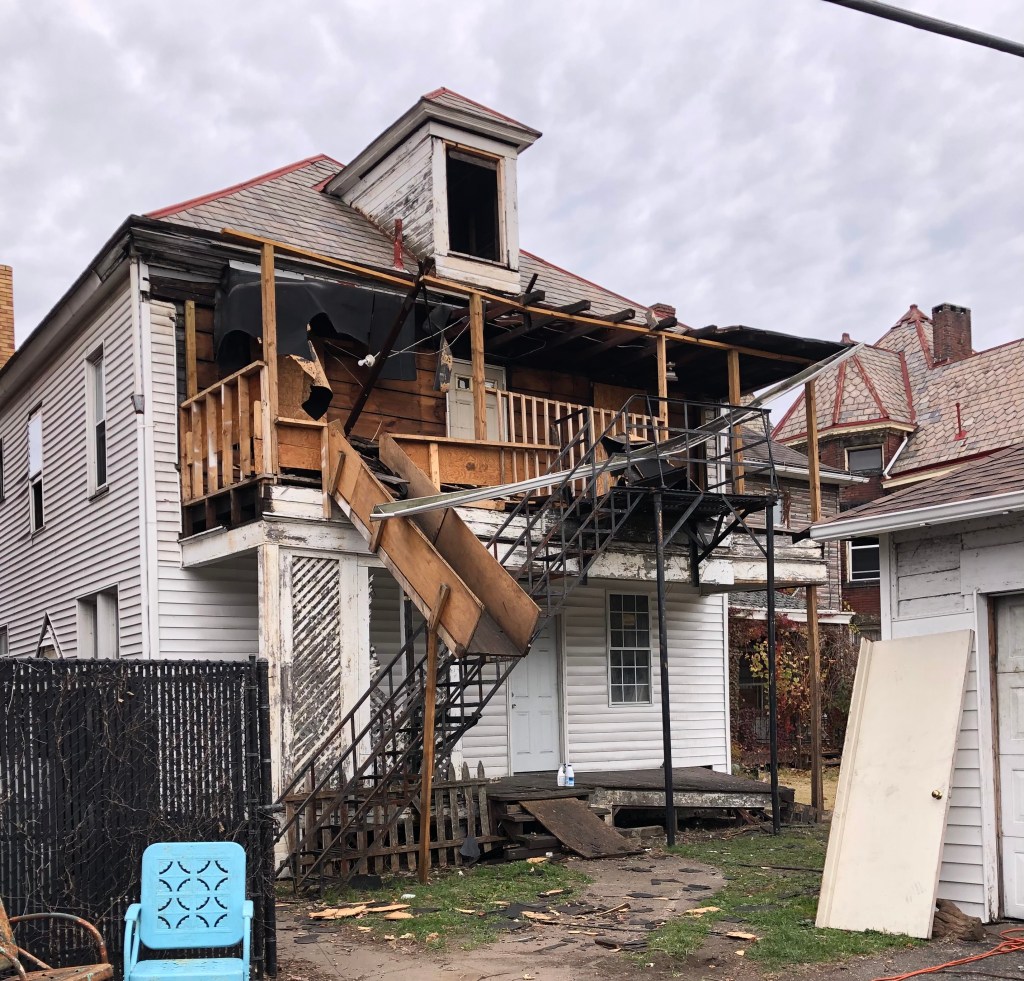
I remember walking in the side door and not being able to make sense of how people lived there. I mean, the toilet was in the middle of the living room floor.
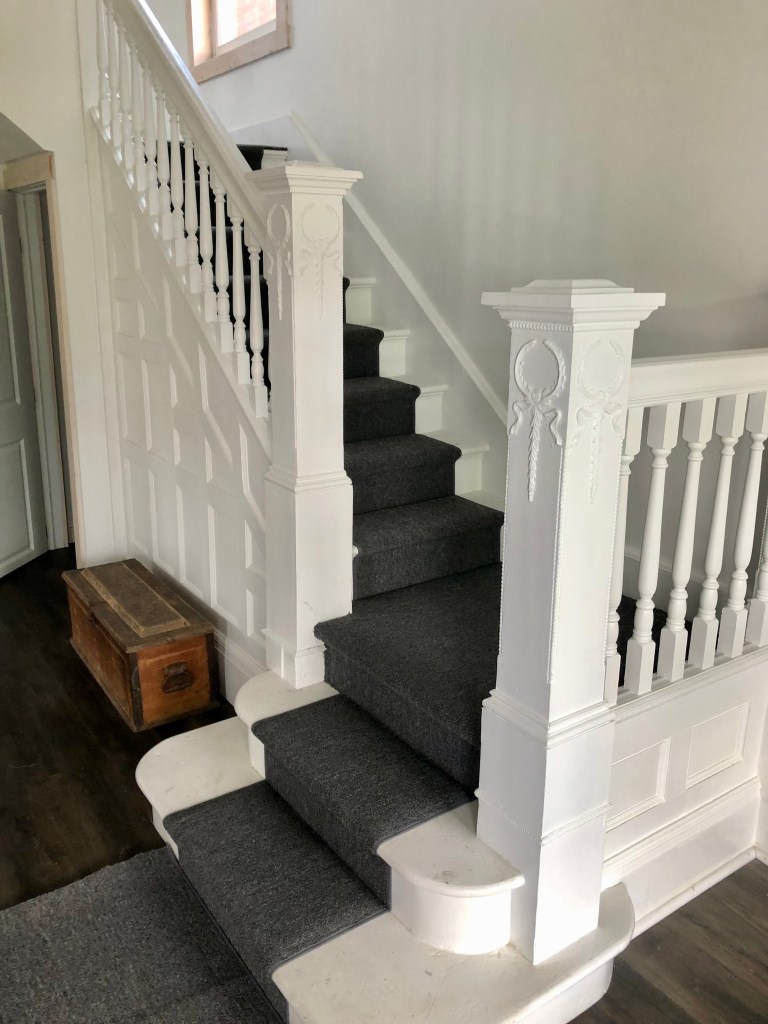
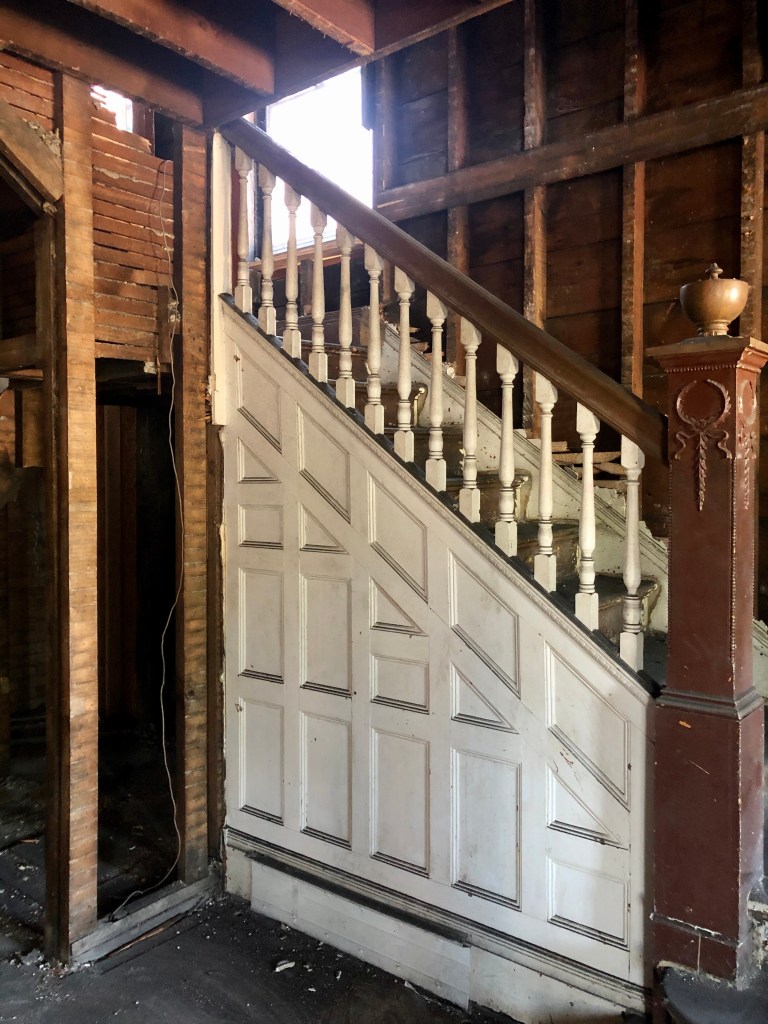
But I think in elements. My favorite element of the whole deal was the Ohio River; my favorite element of the convent was its stairway that still held traces of the 1920s grace with which it was built.
Putting my hand on the banister, I tried to shake it, but it held strong. I said, “even though this place is a disastrous mess, it has got good bones, right?” I was talking to myself, asking if having renovated one house from the studs (CA), one house more cosmetically (MA), and built two houses (MA, MI) made me capable of calling the condition of this one, all by myself. That job normally fell to X. I heard him walking around the buildings voicing his opinions.
It is true that he was the primary construction person between us, but like the entertainment business, I was along for the ride at every point. I never got a credit until I helped produce, but I actually put my own blood, sweat and tears into many movies and all of the houses. I didn’t mind this then as much as I do now.
Over time it will become clear to me that I learned enough to be dangerous, not enough to be truly knowledgeable or wise.
I thought that this very trashed house on Main St had good bones. The second thing I said was: “this will be my home.” (I already had been out of my home for nine months which felt like a lot.) G agreed then, but there was much disagreement. Suffice it to say, everyone had differing thoughts.
An argument was put forth that I should divide the house into fourths or thirds and live in ¼ of it, renting out the rest, part of the “exit” strategy. But back then, I was looking for an entrance strategy. It struck me that if I only had a tiny apartment, I would only be ¼ committed to this experience for however long it lasted. And then I would be responsible for four apartments. I am more the type of person who would like to have a home, and then sell that home one day, if I have different plans.
Selling anything in this area might be tricky, but actually getting into this place proved a lot harder than any of us imagined.
*
Ohio has one of the strictest rules about lead in the nation. Someone without children was evicted from this house—a house he owned, in the midst of his own remodel—because the previous owner, a slum-lord, didn’t maintain it and his tenants’ children got lead poisoning. The landlord did not respond to the state’s appeal to remedy; instead he sold the property before the state could catch up. Eventually Ohio’s Department of Health responded by placarding the house and evicting the new owner without notice. Just as he began installing new windows, reframing a wall, and running new Romex.
He hadn’t even moved in.
He broke windows in rage. Hence the broken glass.
He sold to a broker/developer who bundled it with the church and rectory with the goal of taking advantage of the newly instituted Opportunity Zones, of which this village is one.
Locals understand the lead placard is the kiss of death—or a French kiss with the state—a state that is very unwelcome here in this fiercely independent town. Almost everyone knows how to fix everything, or they’re trying to learn, or they have an opinion on how to do it better than the last guy. The knowledge base isn’t where you went to school, but how to build, remedy or recount the history of something, replete with opinions of uncertain accuracy. The idea of the State of Ohio deciding whether or not you can work on your own house is blasphemy. But I am getting ahead of myself.
*
In mid-July 2020, we purchased the properties and began the process of cleaning up all of them. No one had lived in or used any of the three buildings for a number of years. None of them had been heated or cooled in many seasons. The smells were vile; nature and nefarious sorts had taken advantage of the open doors and broken windows. A neighbor saw a raccoon looking out one of them from the inside.
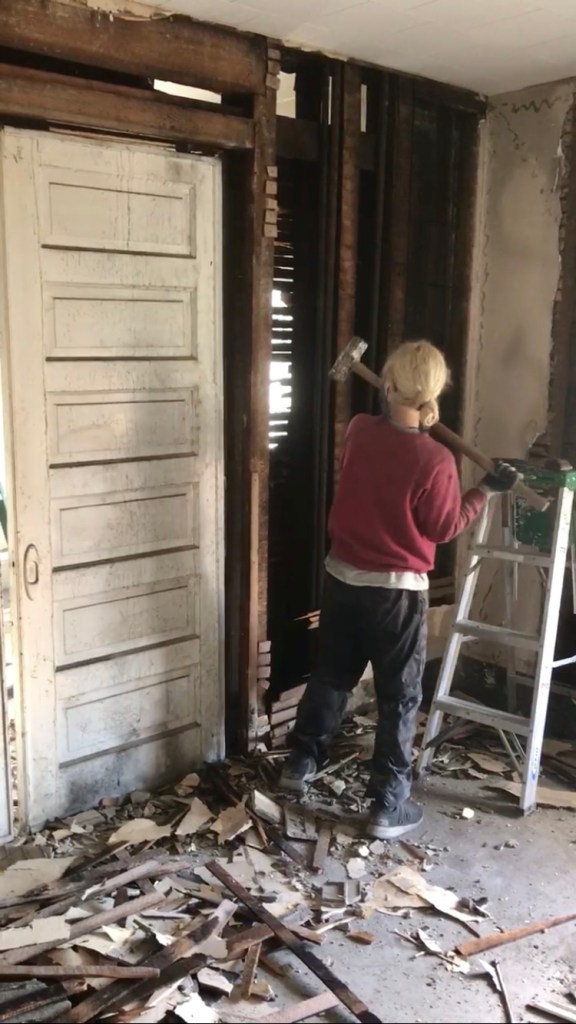
Finding the whole thing completely overwhelming, I went back to Massachusetts for a few weeks to pack, reset and try to steady myself. Before my retreat, I spent a day trying to make the convent look like it was worthy of something more than demolition. This involved holding my breath while I moved the used-yet-disconnected and dried out toilets into corners, sweeping the dirt and glass and garbage into corners, and stacking windows and screens in piles (a previous project from the second to last owner). When I got back in mid-August 2020, all of the scat/feces-infused crimson red carpet was gone. The convent was down to its studs. I would have thought all of the toys would be gone, but evidence of children leaving in haste or duress continued indefinitely. In a putrid basement, we found a washing machine that was left full. Under the structurally unsafe deck, a tiny ballet slipper. It went on like this into the next season, gradually diluting but never fully ending. I am sure there still is glass in the soil. I remember hours and hours of picking it up, wedged in the moss between two houses that could never get completely dry. I remember the smell, too, of the rot and damp and decay.
The debate over four rentals versus a single-family home simmered on the back burner. The convent itself did too. My original thinking was that we fast track it so we could live there during the unfolding of the rest of the project, but other minds prevailed.
*
At varying times, we noted someone working on a home up the street, also with a lead sticker on the door. Eventually X went up to meet R and returned with him to see our project.
In short order and with X’s encouragement, R agreed to help me renovate the convent. He, too, was from out of state and had no idea what Ohio expected of us in this process. X reached out to the DOH to say we were ready to be cleared for remodeling; could someone come out and inspect our readiness?
At this moment we learned that in order to work with lead, even on your own home, you must be certified by the state if your house (or the house you just bought) has been placarded.
Option B was to hire someone who is a lead abatement contractor. There was not a single one in our county.
Eventually it was decided that R and I would take the week-long class (October 12-16, 2020) to get certified as lead contractors so that we could work on our own homes. We drove an hour each day and sat in class, socially distanced and masked, to learn about lead. Our teacher lectured us, unmasked, before vaccines. (Like many locally, he did not believe in masks or Covid but ultimately got very sick and almost died.)
There was an in-class exam on the final day. We both passed. We were told that a certificate of completion would arrive within a few days. The certificate of completion was required in order to apply to take the state exam. After I called to inquire why neither R nor I had received them, they arrived on November 10th.
*
Next we had to apply to take the state exam. I completed the page-long application with references for both of us, with a “documentation of experience” in lead, asbestos, environmental remediation or construction. With a college degree, I needed one year of experience—I had plenty as an owner-contractor. With a high school degree, R needed three years of which he had plenty in construction, and his military record could get his application expedited.
Along with this, we had to include a photograph and a copy of the initial training course certificate. At the time, there was a grant available to cover the $500 fee for the license itself. The class cost $600 each. There was also a $70 testing fee not covered by the grant. We applied, paid and were accepted. [I learn later that most of this is all grant work. Poor families get grants to clean up their homes; significant profits are made by the contractors who bill the state back for their work. The key is having young children in the home to qualify—of course they also are the most at risk for serious side effects.]
A thick envelope arrived with details. We already were told that we could not test at the same facility where we trained. Looking at the list of dates and locations, there were five tests left in the year. The document only provided the dates for 2020. Two of the dates were in 24 and 48 hours. It stated we could not elect to sit the exam less than a week ahead. There were now two options left, 2 ½ – 3 ½ hours away.
I called the training coordinators and asked a few questions. I was put on hold, and magically, a testing site and time opened in Canton. 90 minutes from us.
[On the day of the test, there would be a nor’easter, and I white-knuckled it there and back. Upon arrival, the testing site would tell me I needed to have my social security card, which I did not; no one had told me that I did. I managed my way through that, too. The exam was not easy, the questions not clear, and I did not know many of the answers.]
If we passed, we would be informed in 1-2 weeks. We could re-take it if necessary for an additional $70 each time.
No work was to be done on the lead in our homes until we passed the state exam.
*
It was during class that we spoke with someone in the Lead Abatement department in Columbus, working from home, and it was then that I got to see, read and begin to understand the lead report for the convent.
It was eighteen pages long.
Describing the place as found by the lead inspector just after the children were diagnosed with lead poisoning, it was addressed to the landlord and former owner of the property.
We learned that the report travels with the property. There is no leeway or assumption that a new owner will handle things differently than the cited one.
We learned that no one from the Department of Health was willing or allowed to come out to inspect the property until all of the work was done and it was inspected (by a separate party, for a fee). If it passed, DOH would review, and the placard could be removed.
We learned what lead is, what it does, its historical uses, and its ability to hurt. We memorized the amount of lead that is actionable in soil, air, dust, water, paint, and blood. And we learned about what it means to abate, to stabilize, to encapsulate, and remove safely.
We also learned what our teacher’s opinion was of the president, society and his place in it; how, where and under what conditions he grew up and that he had a crush on neighbor and future NFL coach Mike Ditka’s sister, back in the day. We learned that he had some wealthy friends, and he shared with the class that he checked my fingernails when I walked in to see if, as a woman, I was someone who might actually work on houses. His condescension permeated everything, “Cressey, I don’t mean to keep you out of this, but guys: you need to buy good tools.”
I was the only woman in the class. He made me cry twice, but he only knew about once, when it was obvious. (Not counting when he made me stand up in front of the class and fit-test a mask with stannic chloride. Cue their laughter.)
*
As there was no lead paint left in the convent—except on the stairs and banister which we were trying to preserve—we continued working on it.
We took the test on a Sunday, passed, and received word of it two weeks later.
In class, we were advised to proceed to drywall before getting an inspector for a hopeful clearance. Next I was advised: condition of the house needed to be “pristine.” Or move-in ready.
Months went by. Work was shoddy at best. Money disappeared. Life became a blur. Eventually I would become numb.
With a helper from G’s demo work on the rectory, I stripped the stairs, banisters, newel posts and landings with Peel Away, this crazy amazing product that removes lead paint and is used by the British Museum and other sources trying to restore fine architectural detail. I watched as R’s team working on the rest of the house under-performed, working few hours a day and driving back and forth from Pittsburgh. The days were long for them, naturally, as they had over an hour’s drive back and forth, but we were lucky to get twelve hours out of them. In a week.
After many more rounds of frustration, I told R on a Tuesday it was his last week, and there would be no more money. He was gone before the end of the day without paying his workers, so I went to the bank and did. It was the end of May 2021. He left literally everything poorly done, incomplete or both. [We would not get the sticker off for another year.]
During this time, I interviewed several drywall guys and found a favorite. All of them criticized the half-baked effort before them. One guy wanted an hourly deal, which frightened me.
I purchased and ferried all supplies. I tried to smile. Progress was slow, but the work was good. The convent is, quite simply, larger than it appears. Eventually, we progressed to sanding and then painting and trim. Then flooring and other details. Installing the kitchen and the bathrooms. Until finally it seemed possible I could call lead clearance inspectors. All of whom, I discovered quickly, lived over two and a half hours away.
On August 2, 2022, I started at the top of the list DOH gave me and left messages for five inspectors. By this point, we had lived in Ohio for two years, renting and imagining that this day would come vastly sooner.
*
On Saturday August 6th, a lead clearance inspector walked the house as he reviewed and responded to the eighteen page report. He took wipes from various spots to send to the lab.
He told me I could take the sticker down. He said things would be alright, and our work was good.
At that point, I still figured I would move into the convent. We had been back and forth, arguing about my future for many moons. I felt numb about this, too.
Results arrived the next week, and it turned out there was a fraction too much lead in one of the wipe tests. Apparently this can be from the air in this area. We were told to clean and test again. Test one $750. Test two $250, covering the inspector driving over two hours to get to us, and less than fifteen minutes on site.
A week later we learned that, at last, we were clear.
*
Following this parenting journey from attachment to non-attachment, I cherished every minute. I never expected to find myself burnt out, but this lead-abatement experience played an out-sized role. I have written about my shame, feeling this.
During the past eight plus years, G and I took multiple uncharted paths. Among our many other adventures, I became a part of this Ohio community and discovered that indeed, I could live here.
Over the two years, I found a few wonderful friends. I had the company of G’s sweet puppy for much of the time. But I carried stress about this endeavor that never abated, even after the clearance test. Coincidence or not, I found my new apartment in Pennsylvania within days of the second round of lead testing and receipt of final clearance. The sticker came off the door, and opportunity knocked moments later.
There is still so much unknown in our next steps but what I do know is: the convent is habitable. G lives there now with her pup. While abatement work like we did is normally done with encapsulation rather than removal (which is what we did), it is nice to know that there is no more lead in the house (and we got rid of a bunch of coal dust, too. Coal dust is everywhere; the state doesn’t mind about that.)
I also know: lead paint is all over the village. It is all over the regions of America where buildings built prior to 1978 predominate. Ironically, lead paint has done an incredibly good job protecting these structures.
Topics that once caused sleepless nights, like the lead sticker, disappeared with a whimper. New topics have replaced them—like G’s extraordinary art installation on the former rectory part of the property. The challenging response of some locals to her work-in-progress. And the astronomical pressure this has put on her.
Nevertheless, G led this Ohio project from the start, and in my transition, she leads, still. This has been a deliberate, very awake yet imperfect process out of childhood into adulthood. She has become fluent in carpentry as a new sculptural medium, and has a clear, albeit huge, creative vision for her endeavor moving forward.
As I sit on the other side of these decisions today, I see things more clearly and can begin to appreciate what I learned, how I grew from it, and how I am forever changed by the experience. I have never done that much physical labor—which helped me become more embodied than I have ever been. I wrote a lot, both personally and professionally, and I learned much about life in the Ohio River Valley, Appalachia, Opportunity Zones and the regions of our country that are contracting in size and productivity.
I have become ever more curious about America, in its united sense. Having had the chance to spend more time in the greater Washington DC area recently, I have been able to see first hand the opposite side, too: the expansion of our country’s urban sprawl. Whole towns and zip codes freshly created out of vast open land within thirty minutes of the capital. Fancy housing one on top of the other next to shops, a golf course, marina, school, train stop, sports complex and playgrounds (with planned events and parties for people who live there). All brand new. Surrounded by some of the remaining hundreds of original acres for hiking and biking.*
Manifest destiny for this century?
That is what they are pitching, but does it offer the freedom that our ancestors once had, to create new lives of their own imagining? I look at the prices and I wonder. I look to our village in Ohio and I wonder again.
I wonder if areas like our village that have been left behind might offer just as much, if not more opportunity. The chance to own a home that is affordable and raise children without it costing the moon. Working from home. High speed rails to link us. Fly-over zones redefined as possibility zones. A re-uniting of sorts.
Questions seeded over the past two years will continue to gestate; my nation and worldview, forever altered.
*
Recently I started looking at blog posts I wrote over the past two years, and I stop at a poem, “The Place Where We Are Right.” I stop also at a theme that was a constant in the beginning:
The river works. The trains deliver. Mary stands.
We continue to work, each in our own way, our creative selves more enriched than ever. Mary remains standing in the windows of our church, looking out on the village and looking in at my girl, grabbing her good tools from her studio and heading outside to build.
Perhaps unsurprisingly, I have grown ever closer to Mary in the past two years. I beseech Her to look after my child. I wear Her medallion around my neck and rarely take it off. Faith itself has become an even more important ingredient than ever as we face uncertainty in so many quarters.
Above all, I pray that somehow we are making our lives worthwhile. As I listen for the whisper.
From the place where we are right
flowers will never grow
in the spring.
The place where we are right
is hard and trampled
like a yard.
But doubts and loves
dig up the world
like a mole, a plow.
And a whisper will be heard in the place
where the ruined
house once stood.
– Yehuda Amichai
“The Place Where We Are Right”
*https://potomacshores.com/




Highly enlightening story !! Some of the bureaucratic BS you had to endure is a credit to your determination to do a job right is paramount.. I would have punted 2 years ago!! I tip my hat to you all and your major undertaking, to make our lifelong home a better place!!! Keep your eye on the prize, yinz inspire me & I’m not inspired easily!! Best wishes for your moving forward!!
LikeLike
Thank you, Brian! Always keeping my eye on the prize & caring about your hometown : )
LikeLike
Your work is absolutely amazing. I am so glad you didn’t give up. A close friend of the family lived there as a nun but I was never in there. It’s just beautiful and I think she would be amazed too
LikeLike
thank you!
LikeLike
As I read your words ” I will listen for the whisper”, I was reminded of a sermon I once preached entitled “Why Bad Things Happen to Good People”. I closed by saying ” God will whisper to you, He will shout, He will nudge and He will shove you to get your attention. Do yourself a favor: Listen for the whisper.” Continue to live out your dreams while listening for the whisper. May God bless and keep you throughout your journey.
LikeLike
thank you!
LikeLike
Thank you for all you did for the community Cressey. Don’t be a stranger. I don’t know how you were always so positive. But You sure were.
LikeLike
Thank YOU for all you continue to do. I will be around : ). Take care of you and your sweet family.
LikeLike