There is nothing of me that is alone and absolute except my mind,
and we shall find that the mind has no existence by itself,
it is only the glitter of the sun on the surface of the waters.
–DH Lawrence*
Themes that keep arising: home, childhood, sacredness, intuition, rivers, ancestry.
The place where I find myself today is strangely like a backboard for the bouncing of my selves, my history and questions of my future. I look at what I have desired and what I have resisted. What I have discovered in yielding to resistance as well as what I have found in pursuing desire. I am beginning to see what this liminal space is, this moment of letting children go and allowing in whatever self remains. Whatever self has endured decades of other people’s demands and needs. Whatever self yearns to be freed now that, maybe, she can.
Sitting by the Ohio River, a little over a year ago, I said yes to the unknowable. Another move, away from a region I tried so hard to find, toward my adult-child’s choices. Another action against the grain of tradition in which the adult-child leaves the parent. Embedded in the many “whys” I was asked, I asked them of myself, but with no answer.
I am not sure why the river gave me strength.
The past few weeks I have expanded my thinking around what I would do, were I free. Realizing that while ostensibly I was free to make many decisions up until now, most of them were not. First I listened to my parents, then to my educators; I supported my husband and then I responded to my child. The very traits of obedience and dedication that held me in such good stead for the first two decades may not have been as ideal in the three hence.
Or maybe, no matter what choices I made, I still would be here, asking this. Also: I have grown so very much from the difficult decisions the others made for their own needs, forcing me into discomfort and self-discovery. Forcing me into seeing my own resilience first hand. Forcing me into my shadow self.
And forcing me recently into fully embracing the magnificence of my aloneness.
Someone once said, pay attention to what you do when you only have 90 minutes free in a day, or you only have one free afternoon. How do you spend your elective time? What do you envy in others? What fictional characters’ lives (or what aspects of their lives) do you admire? Whom do you see when you look in the mirror? Whom do you want to see? Whom do you see when you imagine yourself with your eyes closed? What surrounds you? Colors, seasons, landscapes, treasures, people, animals, designs, spaces. What scent, taste, sound, touch?
Having colored my parachute countless times, in hindsight I see a current pushing me, but also I sense that I am about to emerge into larger seas, into a greater unknown than I have ever known. My spirit insists that this is tied to a sense of place, of home, and I find myself holding this puzzle in my hands tightly.
*
My first adult home was in LA, “in the West [where] it is said, water flows uphill toward money. And it literally does, as it leaps three thousand feet across the Tehachapi Mountains in gigantic siphons to slake the thirst of Los Angeles, as it is shoved a thousand feet out of Colorado River canyons to water Phoenix and Palm Springs and the irrigated lands around them.” (Marc Reisner) Los Angeles never was a perfect fit for me. I knew this instinctively as a child—too bright and shiny—but I tested it for ten years as a young married. With the grace of time, I am able to see why I struggled and also what I grew to love about it. But it was always work for me, and I felt apologetic about this as much as it seemed inescapable. My therapist at the time said some plants grow better in different areas. Maybe it’s as simple as that. Because sometimes I felt like I just couldn’t quite breathe properly and I didn’t know why. It was beautiful. It was delicious. I even had friends and favorite places and a decade’s worth of finding where the treasures lie.
It’s not that my homeland in northern California has enough water all of the time, but it does much of the time. All Californians grow up aware of drought and earthquakes. When I read Reisner’s Cadillac Desert—an exposé on how an unlivable place like LA became what it is today through the building of dams and diversion of rivers throughout the west—a part of me just simply breathed in tragedy: I wasn’t wrong. LA knew it had a water problem in 1904. Ubiquitous names like Mulholland are responsible for pimping rivers to water the desert that is one of our major cities. A powerful indictment, Reisner’s book made me furious. It also validated my long held intuition, an intuition I have been encouraged to ignore for as long as I can remember especially by those I needed to obey.
Living in England during seminal years of my childhood, I bathed in the lush green. I brighten in the mist; I lighten in the cool. As I have said many times before, New England just happened to be in my country. It also houses such lush greens. It was home within home. Within home again as it was where I could grow myself away from the entanglements of family judgment.
After the city of angels—as I applied greater weight to the geography of our lives—there have been a lot of rivers nearby. Each seems to have growing significance. I have been sitting, walking, playing or lying next to each of them for almost twenty years. The Mill River in Northampton, the eponymous Deerfield River, and the Connecticut River running through the region; the Housatonic River in Great Barrington and the Hudson River providing a path to the city; the East River [actually a tidal estuary or waterway] in the city in close walking distance to my apartment, and of course the Ohio River now.
*
Each day I walk the puppy upriver and downriver, several times. Often we walk along the edge of the rail tracks, which is as close as one can get to the water’s edge.
Walking upriver, on the West Virginia side we see the Ergon petroleum refinery ahead, and in the foreground, there is essentially a floating parking lot—a place where barges are left, awaiting further instruction. Currently there are at least twelve barges parked. It is also a place where tugs with barges attached will stop as well. Suffice it to say there is a strong commercial/industrial energy going upstream.
[There are dams here, too, but none visible in our stretch. Federal improvement of the river began in 1824, and the “canalization” of the Ohio River was approved in 1878, with it came this area’s greatest prosperity, lasting for the better part of a century. Dams and locks allow the river levels to be controlled and enough water to be present to run traffic year round.]
When we head back and walk with the river on our left, downstream—at this point flowing west—I feel the rivers of my inner self settle. It is possible to hide the crane from the Ohio side terminal ahead behind the brush and see the river’s turn and return south into an illusory vanishing point as timeless as it truly is.
I have imagined squinting my way through time and seeing the early inheritors of this land making their way upstream, appearing almost magically from around the bend.
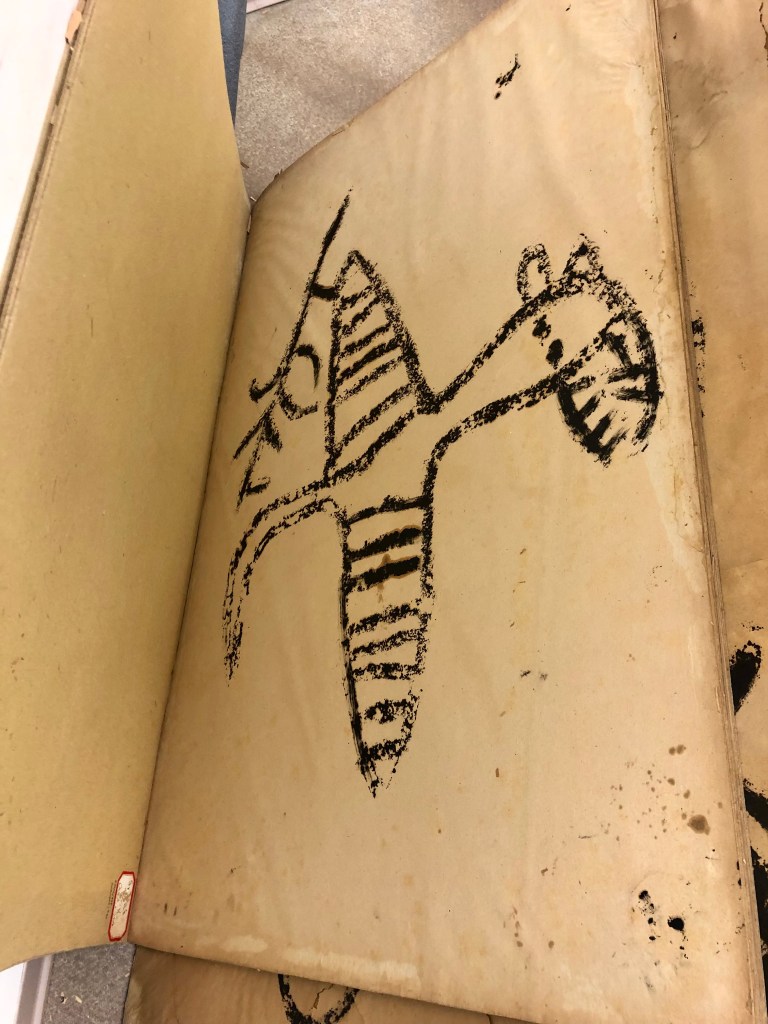
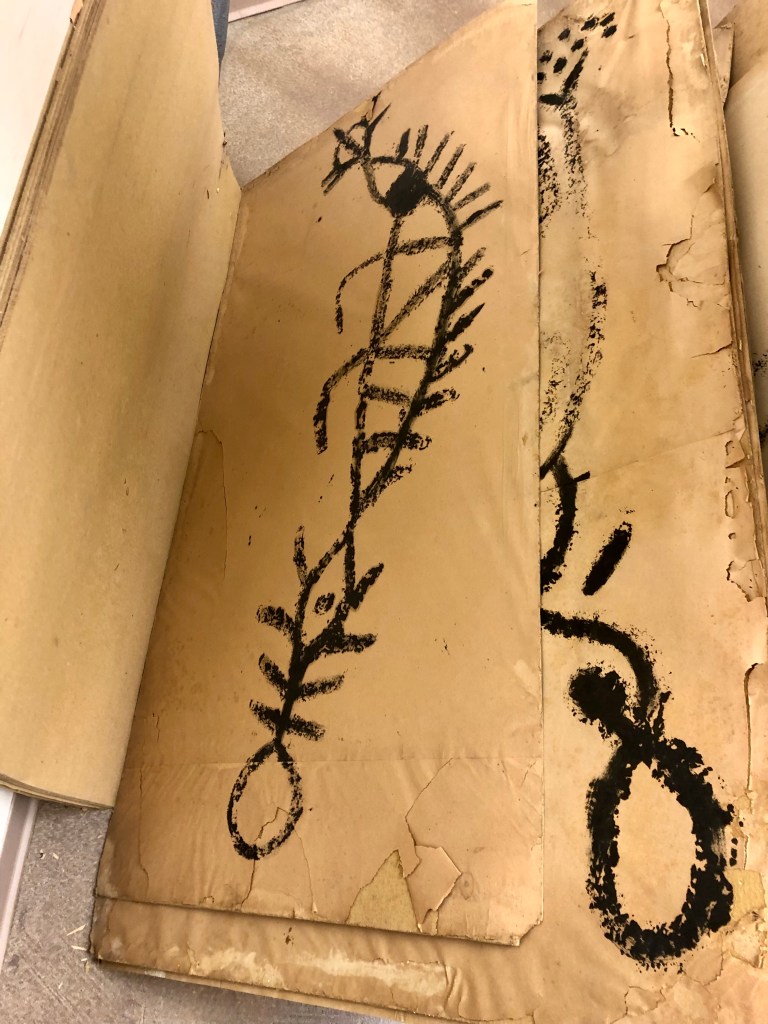
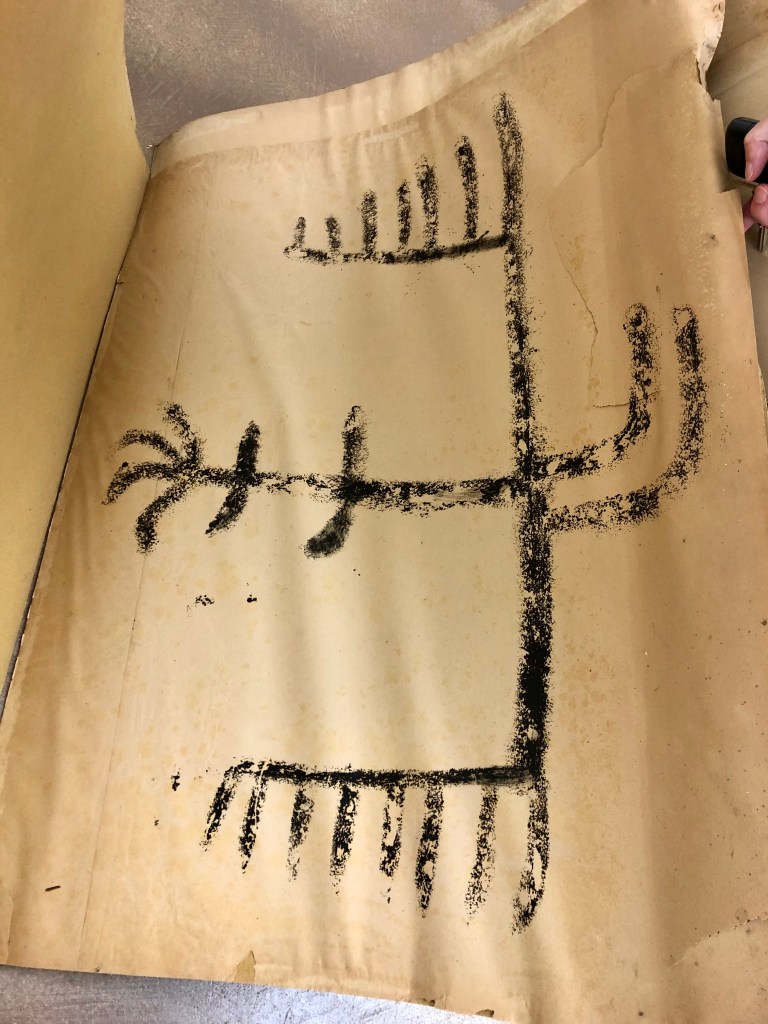
The nearby River Museum is open once a month, for the months of June through September, for four hours at a time. I made time during the June window to glance around, stopping at framed black and white, standard small photographs of petroglyphs carved in stones in the river. Like a reply to my imaginings.
On our massive road trip a few years ago, G and I spent much time studying petroglyphs in the canyonlands especially at Chaco Canyon in New Mexico, and these photographs of now submerged illustrations spark something similar. The humanity of communication. As in the west, it is thought that these carvings were ceremonial, directional or a form of signature. Locally the term medicine marks is used without explanation.
Curious, I study what I can. At the location of dam number 8, on the north end of town, petroglyphs hide under at least six feet of water. There are others nearby, but farther afield. I feel this sense of primordial connectedness.
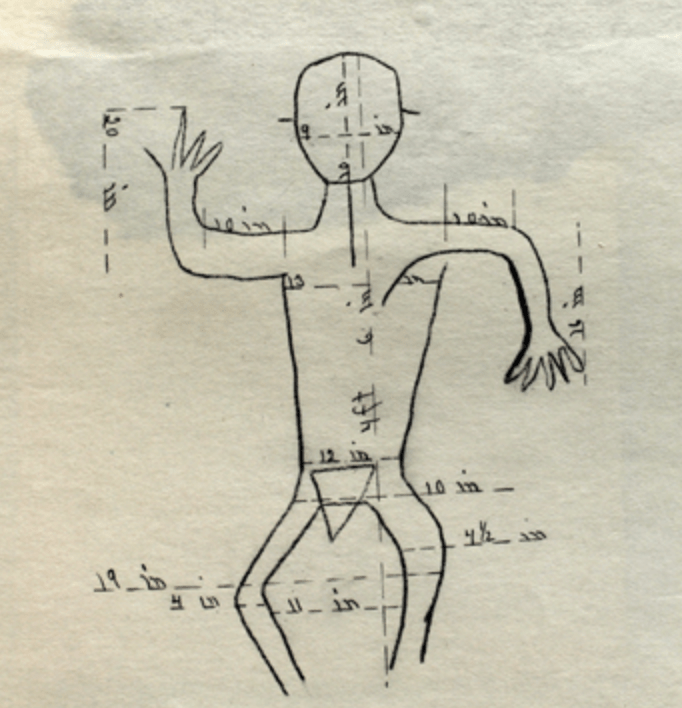
At the turn of the last century prior to the building of this local dam, a young man from East Liverpool [the town next door] named Harold Barth spent much time creating a record of the individual drawings. When I learn that his replicas are in storage at the town’s Museum of Ceramics, I hop in the car, tour all of the ceramics history, and seeing nothing else, I ask: the petroglyphs? In a small clean otherwise empty room in the basement, on what looks like non-archival paper backed by thin cardboard, I see them, each with little corner notes “1908” and the location. They are slightly bent, leaning against the wall, locked away.
Barth’s work was collected and used by James Swauger in his book Petroglyphs of Ohio. He attempted to place the local petroglyphs in time, approximately 1000-1700 AD, attributing them to the “mound builders” who lived the Ohio River Valley “before the Native Indians.” This is the first I have heard of this term.
*
Over the past few months, I have been taking short trips in varying directions. One night away. Sips of oxygen and exploration. Princeton/Lambertville. Dayton. Ashtabula/Geneva. Columbus/Granville. Last weekend was the latter.
I am noting consistencies in these days. I decide at the last minute. I have a very general plan, which functions like a pin. I set myself upon this star and allow for a finding to occur. A mystical co-creation in each discovery. Peace in my aloneness.
My pin for Ashtabula was Lake Erie; my pin for Columbus was a Korean grocery store. The magic of Ashtabula was the bounty of gorgeous countryside and covered bridges; the magic of Columbus was many crystal shops and a greater understanding of the city. In both cases, I wound up driving a horseshoe shape around the area, one energy bleeding into the next, and in all of these trips, I ended the day feeling expanded, more truly me than when I departed.
The Columbus Saturday afternoon, a storm crept up, and I wanted a place to rest away from the urban. Starting to drive back east with a pin of Denison University, rains pounded. I got to my inn completely soaked. Unknowingly I found a town designed by people of Granville and Granby Massachusetts, one county away from our old home. I heard myself exhale.
With a cup of tea, I opened up the welcome binder and saw a list of essentials—wifi codes and other basics—plus a recommendation for a tour of the local Mounds Builders site in nearby Heath (also a Massachusetts name). A pin for Sunday.
*
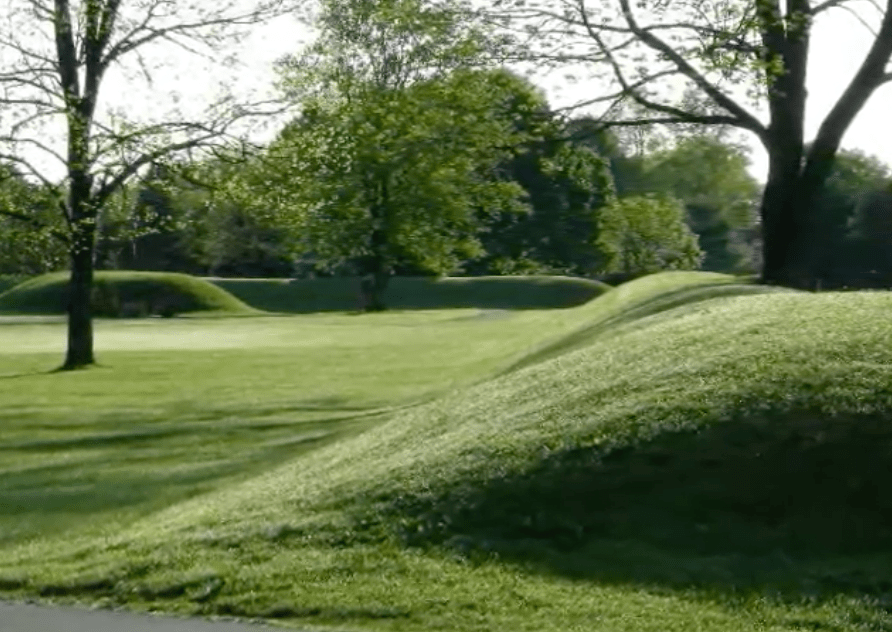
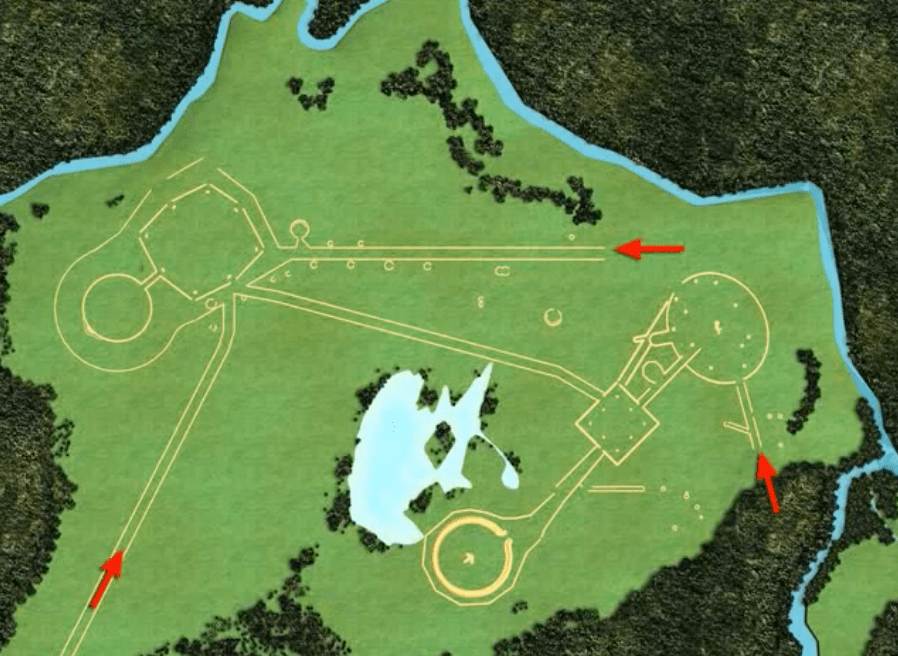
This is how I happen upon the largest geometric earthwork complex in the world. What appears to be a sustained small hill, mounds and ditches in a park-like setting belies—or successfully has protected—a sacred space over two thousand years old.
A circular hill with a moat-like ditch on the inside, and an opening to the east, the entrance is on an axis that aligns with the northernmost rising of the moon. The earthworks “include additional alignments to all other key lunar rise and set points in a cycle that takes 18.6 years to complete.”
Just like Chaco Canyon, Callanish and Stonehenge.
Located on an elevated piece of land between the south fork of the Licking River and Raccoon Creek, originally it comprised more than four square miles. This sheer scale, combined with its lunar accuracy, is hard to fathom. An estimated seven million cubic feet of earth had to be moved to make it using three different types of soil topped with clay to seal the basin.
Since the arrival of the first European explorers, the area was already overgrown with trees over 400 years old seeded in the mounds. Over the years, the area has been used as a training location for local soldiers en route to the Civil War, fairgrounds and a private golf course. In fact, Mound Builders Country Club still holds a lease on part of it until 2078 with a few “golf free days” as concession to those who seek prompt return to its sacred status.
As the nature of this space was unfolding in my consciousness, I stood in a state of amazement realizing it was a few minutes after the new moon was exact, on August 8th, or Lion’s Gate, a date observed by some as a spiritual portal. I took a moment to speak my own rendition of the classic Shamanic cardinal points blessing that always captures my heart. Speaking to faith across time, to nature’s ability to teach, and to what we can discover from it, as Emerson said, “learn from nature the lesson of worship”:
To the winds of the south, elegant serpent,
help me to honor this time and shed the past.
To the winds of the west, sleek jaguar,
help me to see in the dark and find my way.
To the winds of the north, magical hummingbird,
help me find stillness in flight and the nectar of truth.
To the winds of the east, majestic eagle,
help me to fly, somehow.
To the infinite heavenly skies, thank you.
And to the deep rich earth, thank you.
As I put my hands down on the ground, I thought of the hands that built these mounds and this site, about their sense of ritual and natural worship. About the vastness of what was known, millennia ago. And the vastness of what we do not know today.
Hands on the earth touching earth that was moved by countless ancestors, I felt echoes of Robert MacFarlane’s chat with Krista Tippett about deep time—in which he speaks of newfound knowledge found in the earth’s crust, seven miles beneath our feet, two times the size of all our oceans with a biodiversity exceeding the Amazon.
To a sacredness beyond sacredness.
When I get home, I listen again to his poetic words and transcribe:
Deep time is measured in units that humble the human instant
Millennia epochs and eons instead of minutes, months and years
Deep time is kept by rock, ice, stalactites, sea-bed-sediment
And the drift of tectonic plates
Seen in deep time things come alive that seemed inert
New responsibilities declare themselves
Ice breathes
Rock has tides
Mountains rise and fall
We live on a restless earth
– Robert Macfarlane, Underland: A Deep Time Journey
*
We live on a restless earth.
I listen. I hear.
Yes.
I, too, am restless. Restless to know where I am going. Restless to transform into someone other than a mother. Restless to understand what I feel and restless to impart something. Restless to become.
In fragments, I get whispered answers. Awaking one morning, I sense myself in an ancient hand-hewn boat not much larger than my body, floating downstream. I am lying on my back, looking at the sky and passing trees. I calm and hear this quiet message: you already have worked so hard. Please rest in this. You will progress regardless of how hard you push, pull or attempt to stop movement. You only have so much control of the outcome. Pay attention. Focus. Notice. Follow from the pin to the discoveries and see how there is no restlessness then. Or right now. In the heart of the creative moment.
Only awe.
Wonder.
Gratitude.
Relief.
Not so far away after all.



* This DH Lawrence quote from his work, Apocalypse, has held a special place in my heart since I read it in Professor Litz’s class. I transcribed it in calligraphy and framed it for my mother, found an early edition in San Francisco, and I asked for this greater chunk of the passage to be read at our wedding, “For man, the vast marvel is to be alive. For man, as for flower and beast and bird, the supreme triumph is to be most vividly, most perfectly alive. Whatever the unborn and the dead may know, they cannot know the beauty, the marvel of being alive in the flesh. The dead may look after the afterwards. But the magnificent here and now of life in the flesh is ours, and ours alone, and ours only for a time. We ought to dance with rapture that we should be alive and in the flesh, and part of the living, incarnate cosmos. I am part of the sun as my eye is part of me. That I am part of the earth my feet know perfectly, and my blood is part of the sea. My soul knows that I am part of the human race, my soul is an organic part of the great human soul, as my spirit is part of my nation. In my own very self, I am part of my family. There is nothing of me that is alone and absolute except my mind, and we shall find that the mind has no existence by itself, it is only the glitter of the sun on the surface of the waters.”
Reference:
PETROGLYPHS –
eastliverpoolhistoricalsociety.org/indianrocks.htm
Dam No. 8 petroglyphs lie between Wellsville at 80° 39′ West Longitude, 40° 36′ North Latitude, and Dam (Lock) No. 8 between Wellsville and East Liverpool at 80° 37′ 25″ West Longitude, 40° 37′ 15″ North Latitude (Swauger)
MOUND BUILDERS –
http://www.ancientohiotrail.org/sites/newark
DEEP TIME –
Podcast: On Being with Krista Tippett, “Worlds Beneath Our Feet” with Robert Macfarlane


Cressey! Thanks you for yet another piece to appreciate and connect with. Most acutely at present I totally relate to the joy that comes from spontaneous solo exploration. There’s a way of being present to place when one is alone that’s hard to accomplish when pulled by even the most beloved of companions. Puzzles pieces come together. Prayer flows more readily. At least, that’s how it feels at present. Who knows? Maybe this feeling will change like so many things!
Also: Golf free days on ancient, likely sacred sites. Mon dieu.
LikeLike
Mon Dieu is right! I can’t even. I have loved my solitude all of my life, but there is something about now that creates far greater allowance for it and far less self-consciousness. It’s almost like living prayer (actually the topic of my Interfaith Ministry thesis : ), although I didn’t have this bit of material yet!) So basically: I agree and thank you for your thoughtful response and comments. xox
LikeLike