Across the Ohio River, we look at West Virginia. (West Virginia owns the river, despite Ohio’s plea to the Supreme Court for its namesake.) We can see the West Virginia train on the other bank, and at night, lights on their parallel-running road display intermittent ribbons of red and white. Sometimes we can hear their sirens in the distance.
Until this week, I have been driving a car plated in Massachusetts and carrying a Massachusetts driver’s license.
In my little vault is a new social security card with my old name on it, a name I last used on March 6, 1992, the day before we were married. We have been divorced for almost nine years.
While I knew it was going to be an administrative nightmare to change my name at any point, my reasoning for waiting this long was more personal. I really wanted to share a last name with G when she was little. This seemed both logical and natural as she grew up, but now that she is an adult, the opposite feels true. I have begun to feel falsely identified with a name I have carried for almost thirty years. I am not Hungarian. I am not a member of the family with the surname I am carrying. Recently I started to feel a visceral response to seeing my first name and their last.
I do not belong to this name. This name does not belong to me.
On my fifty-first birthday, I followed Covid protocols and sent my passport, birth certificate, and application for name-change to the Massachusetts Social Security office up the street that remains closed to the public. I tracked the package. After ten days of no reply (tracking indicating that it was stuck at the post office), I went into ours and asked for help. Great Barrington called Pittsfield, and the answer they received was, “oh, Social Security just picked up their mail today.” It took weeks, but eventually my passport was returned, and under separate cover, I received my new social security card with my old name on it.
It will take many moons to get my name completely transferred. It will take some time for my old name, signature and initials to become native again. Although it feels far more right to resume carrying my dad’s surname, my childhood name carries no adult identity to me. The last time I used it, I was less than a year out of college. My dad was still alive.
In a way, I don’t completely belong to this name, either. But I will. I do know that I smile when I say it—like some inner joke with myself, a high five—I’m back. Or at least: I’m on my way.
*
When I arrive at the Ohio Bureau of Motor Vehicles (BMV), I have done my homework and carry with me certified copies of my birth certificate, our marriage certificate, and our divorce decree.
I also bring an attested copy of my court order for name change that was signed by a judge in Berkshire County just as the trees finished dropping their leaves last year. G came with me to get the forms and encourage me. At that time it was more of an idea than an insistence, a step into something I wanted to tell the universe: please, something new.
In hindsight, this was something I had to earn, even the insistence. We had months of struggle ahead, not to mention the full paralysis of Covid. Had I waited the courts may not have processed my request.
Armed with all of these documents plus my new social security card, documents from two different sources with my new Ohio address, and the MA title of my car, I proceeded through the multi-stepped process of moving officially to a new state. BMV, Municipal Courts/Title Department, BMV, and BMV again.
*
As you may know from my last post, the place we now call home is a property that includes a church, rectory, convent and garage/shed on the aforementioned Ohio River in a small town that has been hit hard by the collapse of the steel industry and the rise of globalization. A town with a glorious past, now a shadow of itself, along a river that divides states but also once functioned as a continuation of the Mason-Dixon line, dividing the free and the enslaved. It is said that near our point on the river, many swam to freedom and were received by families on our street, a station on the Underground Railroad system.
Of our three buildings, here is the status. The church is safe and dry. The 42 fifteen foot pews have been unbolted from the floor and consolidated in a smaller space as we seek new homes for them. We have offered them (and/or the brass commemorative plaques attached to them) to the families of former congregants who donated toward their purchase in the first place. Many have taken their plaques and shared stories of marriages, baptisms, funerals and weekly routines. And of long lost family members, friends, neighbors, and in some cases, connections to the Catholic Church.
Unlike many parishes whose attendees dwindled to none, this church was closed despite a devoted congregation. So devoted that they fought all the way to the Vatican to keep it open. While Rome decreed that the closing recommended by the local bishop was “not as ‘sufficient and grave’ as required by Canon Law,” it still “upheld his decree.” This process began ten years ago. Five years ago the church was “relegated to non-sacred status.” *
Clearly the pain and feelings of outrage are still fresh, but by and large the people are kind to us. Five years may have been just long enough for them to fear their church joining the countless other abandoned buildings as they succumb to entropy, mother nature, and communal and economic neglect.
I try to prepare former parishioners before they walk inside. The stained glass window of Mary stands over our worldly possessions, all boxed and binned, on what-was-formerly-called the altar. G sees possibility in materials far and wide; the next thing they will see is piles of lath, plaster, mesh, tin ceiling, and anything else that has caught her eye. There will be brick soon. Lots of it.
*
The greatest joy for me is seeing the light back in G’s eyes. For the conventional thinkers among us, there was a sense that we needed to make haste to get space ready for her to create. But she responded with vehemence: This is sculpture. I am doing it already.
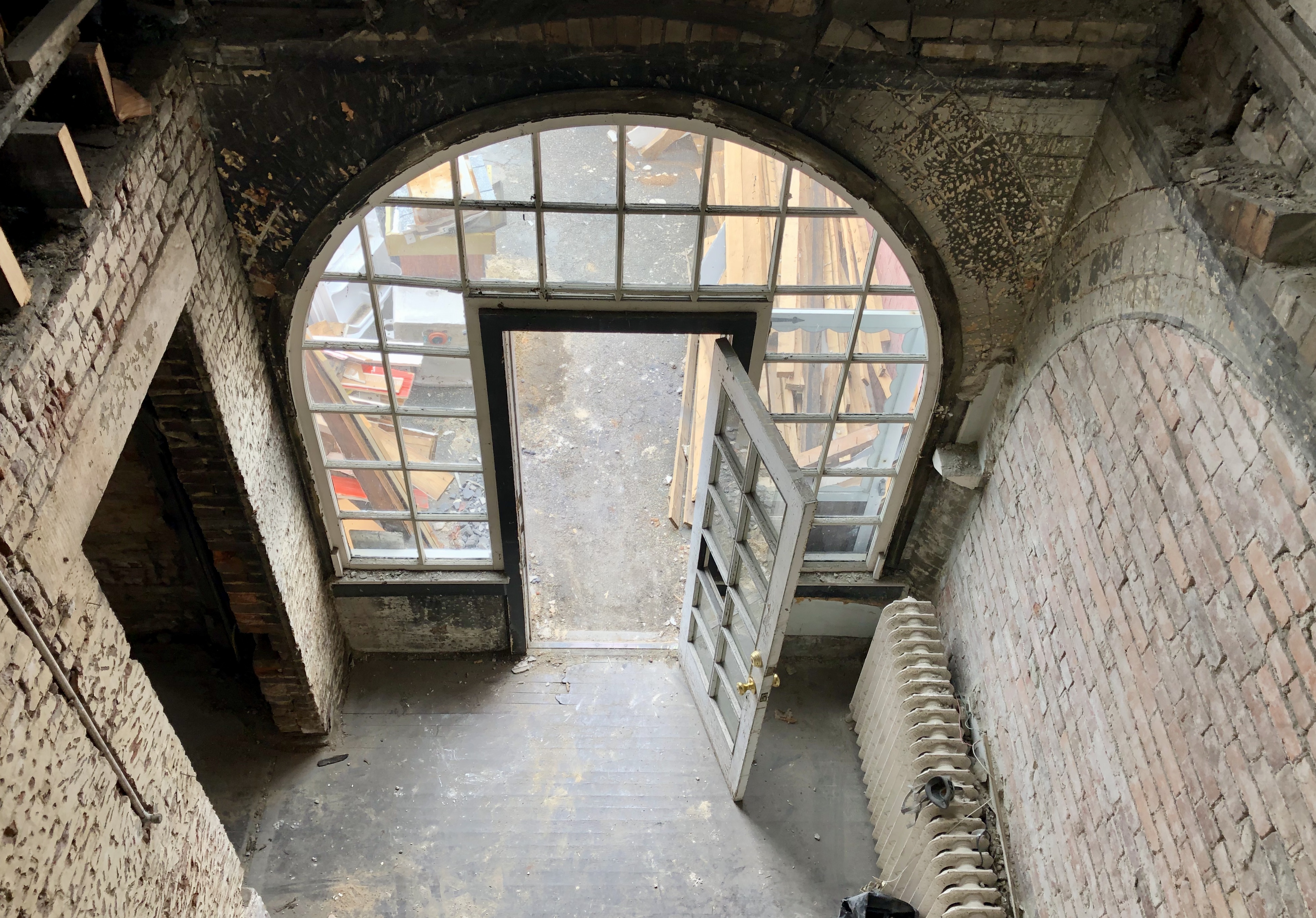
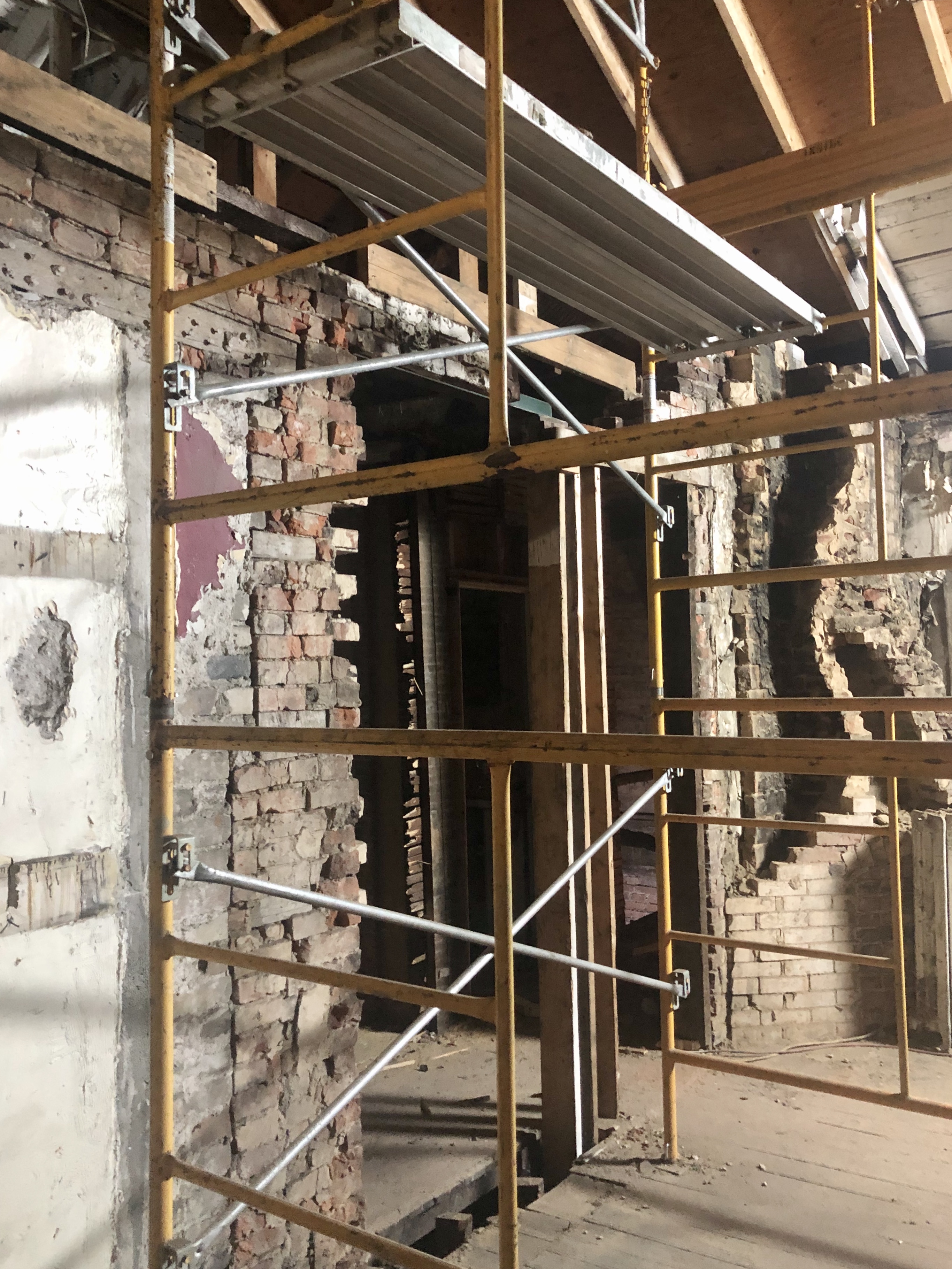
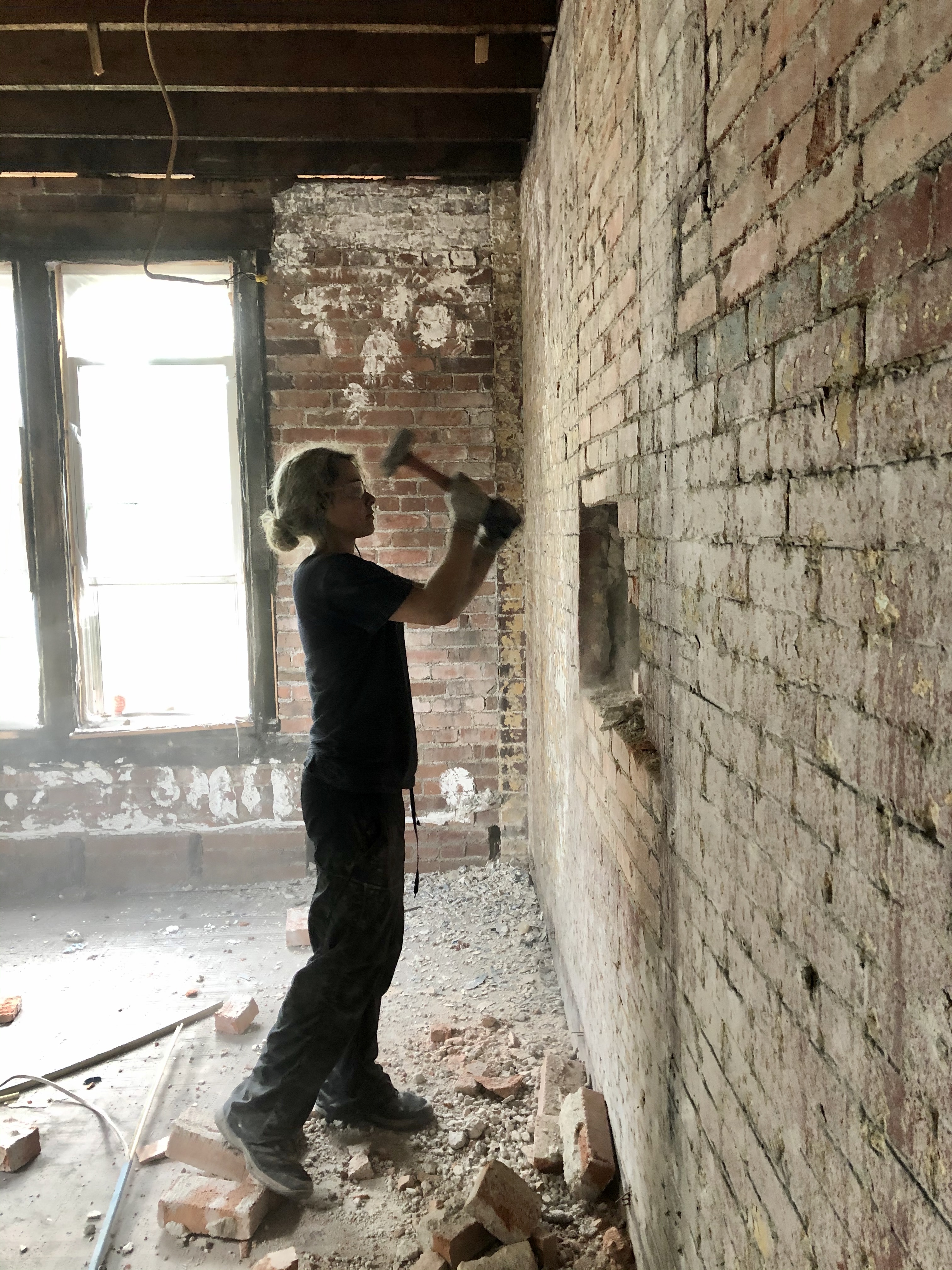
Rather than re-plastering and painting, all of the lath and plaster is now down; most of the non-load-bearing “stick”/framed walls are too. This has revealed not only a brick house on the exterior, two courses deep, but also on the interior. She is opening up ceilings and cutting out some floors creating a clerestory. Already the rectory bears no resemblance to its erstwhile rigid formality nor its recent history as a slumlord’s ready cash source.
There is brick in abundance as she clears old closed windows to the meaty wood headers, or as they put in angle irons to support the less meaty lumber and bring in more light.
[It is local brick; there is clay in the soil. One of the many ghosts of globalization: locally manufactured china. Fiestaware, Sterling China, Homer Laughlin, Colonial Pottery, Sebring Pottery. Not all in town, but in spitting distance. This area once produced so much.]
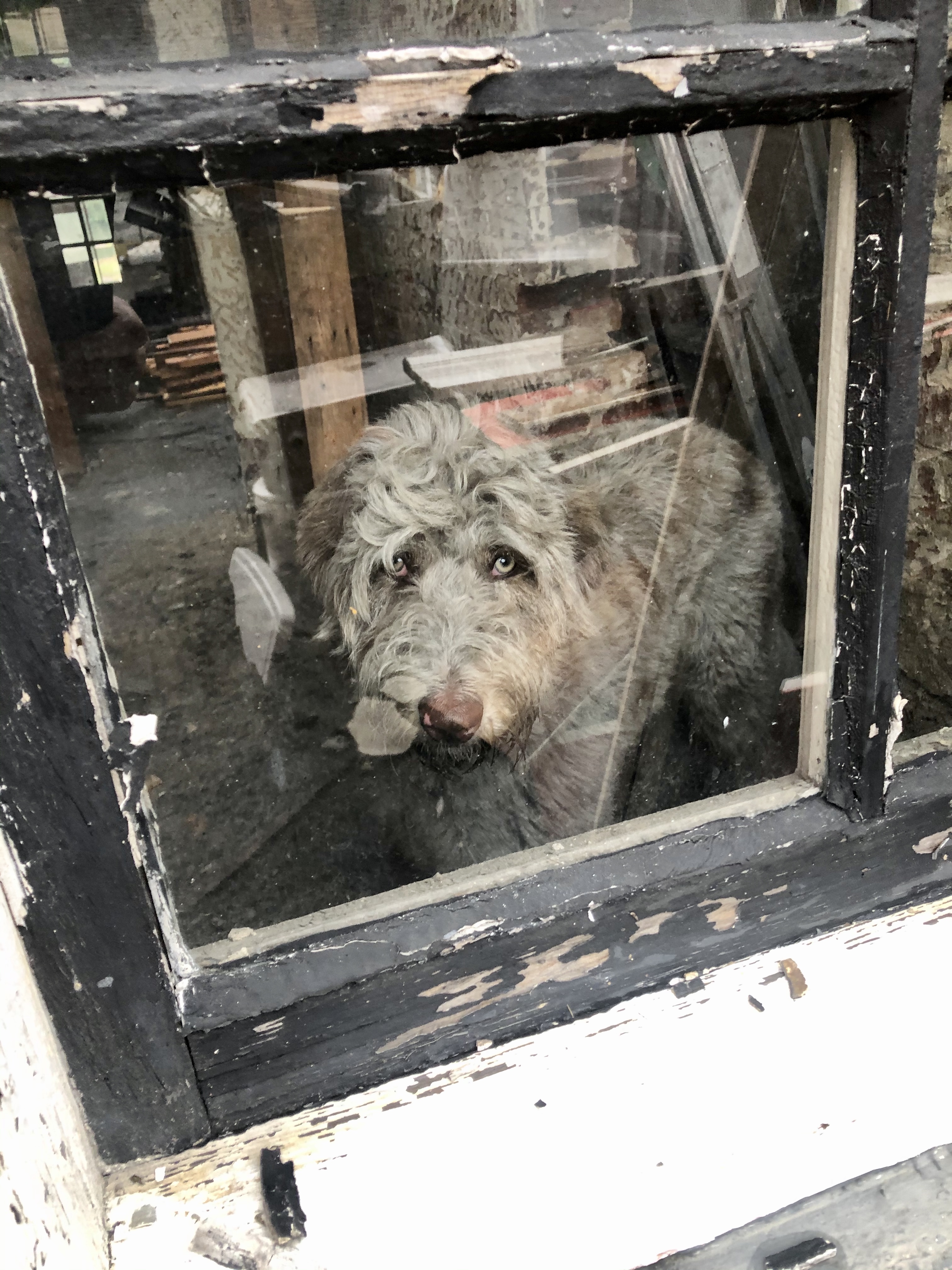
It is hard, dirty work. Coal has been used to heat all of these buildings for over a century, leaving a thick coating of black soot in the ceilings which, when removed, rains down on everything and sticks to sweaty skin. The dog’s fur color has greyed.
G and X work long days; she often does an additional shift late into the night. She also has joined—and been embraced by—the volunteer fire department which provides her with random breaks around the clock, some more thrilling than others. Her two states are construction and destruction. She reports fascinating correlations like learning electrical wiring on site, and then later, what an electrical burn smells like, looks like, and what to do to stop it from consuming a home (if they get there in time.) A highlight: CPR on a dead dog brought back to life!
*
While much of this state-business is clearly literal, it perhaps goes without saying that I am between states of mind as well. Two posts ago I spoke of leaving NYC, something I hesitated to share widely as many in the city suffered far bigger losses than I. It’s hard to imagine a greater shift of thinking and living than the Upper East Side to Wellsville, Ohio. From a place typically teeming with opportunity and abundance to one that has been hit over and over again by loss after loss. The sociologist in me is fascinated; the realist in me is shocked; the idealist in me is freaking out. I am trying to mute the other voices—the critic, the doubter, the saboteur.
I cannot tell you how many people have looked at me and asked: “you’re moving here?” “You’re moving here?” “You’re actually moving here?” “Are you going to stay?” “You’re going to stay?!”
I see it for myself: this America is hurting. Deeply hurting. I see what I couldn’t understand from a distance. This is another land completely from the Northeast, city or village; this is another land from both coasts I know and love. (This is another land from remote towns all over that have been redefined as second home communities, which have their own issues.)
These are proud, strong people. For many, the past is the only good thing they know; change is frightening even though it’s the only thing that might save them. Younger minds fight with their elders over this very point. I wonder if they can’t see the decay; I wonder if they see Main Street the way it once was? They will vote for the past. They will vote for promises. They will vote to protect themselves.
It’s early days, but I feel both inspired by G’s work and growth and the opportunity moving here has afforded her, and concerned for this town and its own state of existence. I am beginning to feel the lack of trust within the community—the effect of people who are lost, idle or worse.
*
Continuing to get inspiration from the river, I observe its extraordinary multiple roles as drinking source to millions, recreational waterway, and true utility tool. Barges pass by, day and night, with a crew on board the towboat working for four to six weeks at a time. (At night towboats look like floating houses with bedroom windows lit.) All in, one towboat can move up to fifteen barges at a time, carrying close to sixty tractor trailer loads (or 13 railroad train hoppers).*
The river works while the people await jobs or lose themselves in the waiting.
Mary stands, protecting our ideas, our things, and our sense of possibility.
Main Street limps along while someone is restoring the old movie theatre, and the clubs thrive (Sons of Italy, Eagles, Masonic Lodge, VFW, among others), hidden from the eyes of non-members like me.
“There are no natural disasters here,” one of our helpers said yesterday. He paused. “Well, I guess you could say the people are the natural disasters.”
And yet, people live here and love it. They call it home. My girl does too; so shall I. (Now I have the license and tags to prove it.)
Meanwhile I am taking this time to step both back and forward into my name and place.
It is not lost on me how very physical these days are. I am seeding grass, clearing pathways, removing weeds and bramble, stripping paint off steel, chipping plaster from brick, running errands and imagining how the convent will be rebuilt now that it, too, is down to its studs.
Each day is so full it feels like a lifetime of emotions pass through me. We live temporarily as the threesome we once were. I grieve and rejoice and fear and calm and cry and laugh and pray and listen, all in the hope that each of us will find our own way into tomorrow.
From the place where we are right
flowers will never grow
in the spring.
The place where we are right
is hard and trampled
like a yard.
But doubts and loves
dig up the world
like a mole, a plow.
And a whisper will be heard in the place
where the ruined
house once stood.
– Yehuda Amichai
“The Place Where We Are Right”

* Sources:
http://thevilleview.blogspot.com/2008/04/wellsville-underground-railroad-part-ii.html
https://www.ctlowndes.com/blog/tow-boats-and-the-ohio-river.aspx


Welcome back Cressey Belden. Lots of love
On Sun 13 Sep 2020 at 4:26 PM Where I End & She Begins wrote:
> > > > > > > Cressey posted: ” > Across the Ohio River, we look at West Virginia. (West Virginia owns the > river, despite Ohio’s plea to the Supreme Court for its namesake.) We can > see the West Virginia train on the other bank, and at night, lights on > their parallel-running road display ” > > > >
LikeLike
Wow, holy wow. You are amazing and so is your daughter and dare I say X. She is a sprite with a big hammer. How proud you must be. How brave you all are and I can’t wait to see the end results of this project. I cannot even imagine all the emotions that you have traveled through over the last few years but soon, maybe this will really feel like home. One thing for sure is, G is all grown up and she is going to do amazing things. Her vision is big.
So welcome to your new home, your new state and your old name. May you grow in love with each of them. I wish you great happiness and joy. Pat yourself on the back. You have done a great job with that spirited little one of yours…Blessings all around. xoxo
LikeLike
BTW…I love all the photos…they tell their own story but the one with the dog is just so darn cute.
LikeLike
Sorry – I spelled Xandy’s name incorrectly in below email. 😩
Sent from my iPhone – Peggy Porter
>
LikeLike