“Our Lord does not look so much at the greatness of our actions,
or even at their difficulty,
as the love with which we do them.”
– St Therese of Lisieux
A few days ago, I asked myself a question: When does it feel like I am the most loving to myself? Answer: writing, reading, resting, and praying. (I could add walking, but even that is an effort, albeit redeeming.) The spark of this exercise is remembering how great it used to feel to hang out by my Aunt Jane’s pool, long ago, on a hot summer day—just after term was over—when I was finally free to bask in peace and light, in ideas and stories while floating on (and then dipping in) the water, an icy Diet Coke nearby.
In contrast, I notice how, throughout my life, often I am simply surviving. Following the requirements. How, much of the time, I have been pushed into things, with brief, delicious respites, like Aunt Jane’s pool. Self-love is finding and savoring these respites.
Today, my notebook is a portable form of self-love. (Raw material, no judge.) Today, poolside is my bedroom.
Today, no one is pushing me (most of the time); there is no apparent wind.
*
Recently, I realized two things. One: My mother trained me to consider first what other people might think of my behavior, to observe myself from the outside. She pushed me out of myself from the start, forcing me into things I was not ready to do nor comfortable doing. I grew proud of my ability to survive these tests. (I still am.)
And two: To me, to love is to please. To feel loved is to be thanked.
Looking at poems I wrote in my thirties—when G was a baby—I see evidence that I was aware, even then, that I survived by shutting down aspects of myself. The work I’m doing now? Bringing more of me into the light, all of the varied instruments in my symphony. I can no longer maintain long-term fight-flight-freeze-fawn mode. Each time I am at full-throttle, it takes a larger toll. I can feel it, in my body and in my soul.
*
In previous posts, I have shared our experience in Ohio, living and creating.
(blogs titled: Ohio, Part 1-11)
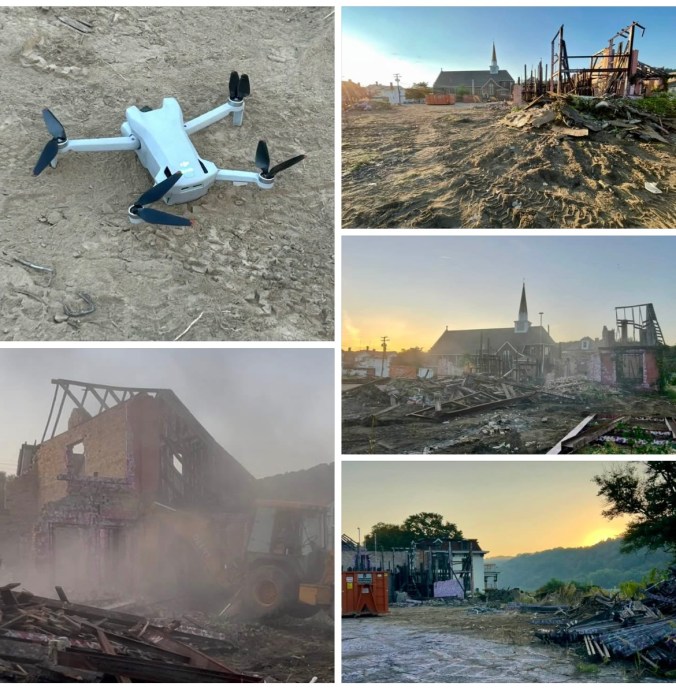
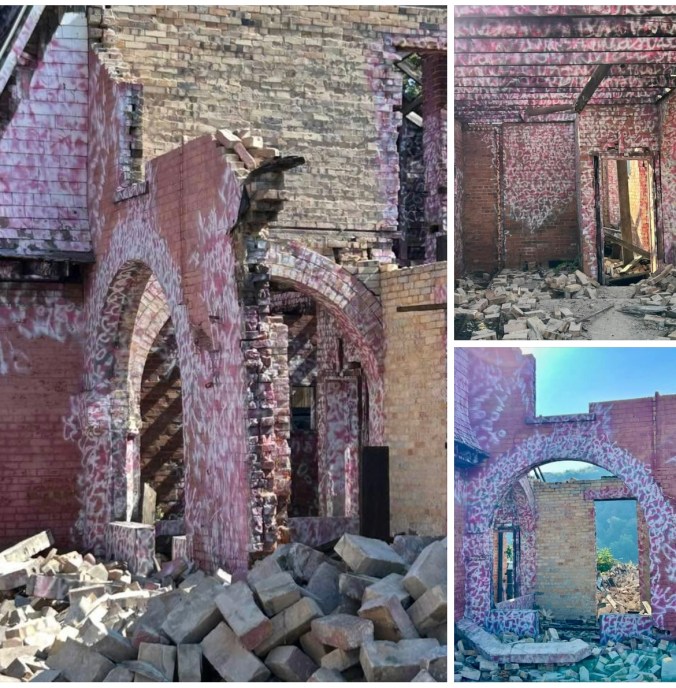
This June, my daughter, G, started taking down her art installation. She worked intensely in the baking heat, just like she did acquiring the materials and building the massive sculpture in the first place.
In August, I said to her, “Stop soon, catch your breath, and then head back to campus. Tell me what you want to keep. I’ve got the final bit.” I had just found someone who could complete the demolition and back-fill the pit.
He started in early September and has made some progress already.
It is time for me to do my part.
*
In advance of travel, I boost my prayers, spending some time in adoration, and going to Mass. (It is not lost on me that my participation in the Church has grown exponentially since we acquired the de-consecrated building where G now has her studio, where—as I wrote five years ago,“Mary stands, tall and proud, in the perfectly preserved stained glass windows … She will stand over my baby as she creates.”)
The day before I leave home, I make time for therapy, acupuncture, and massage—to try to ease the radiating pain in my hip—and to ready my energy as best I can.
On the day of departure, I get up at four and leave about 4:35 AM. Arriving about 11 AM, I hit the ground running: cleaning, organizing, meeting, supporting, thanking, and greeting; in the afternoon, I head to the Pittsburgh airport to pick up my former husband, X.
We are teaming up for this effort.
*
I cannot imagine being here, coordinating this, alone. I am truly grateful for his help, our few loyal workers, one local friend who is my lodestar, and the guys doing the clearing: two brothers with one backhoe-loader.
They are strong and determined. At one point the tractor’s piston breaks. They need a metal hook to fix it. Since G is a keeper of all things, I believe we must have something that will work. We search everywhere for a tool. I find a piece of metal the width of rebar. They bend it hard. It fits the bill.
“We MacGyver,” one of the brothers says. In spite of everything, I genuinely like the spirit and ingenuity of many people I have met here.
When I am on duty like this, especially on this site, I am like a machine, making lists, making things happen. Like a dummy, nothing hurts when it hits. I am not inside me. Things I prefer to forget, I see how they return. Someone says, “Remember how angry you got?” Now I do.
I made many mistakes. I trusted many people in vain. Even just last year, I trusted our first and only tenant, letting her pay at her own pace, as long as she looked after the place I had just renovated. She said she would; she had a reference I trusted who spoke on her behalf. But when she moved out there were destroyed appliances (yes, plural), holes in walls, gashes in doors, and even a broken sink. It stank. It was filthy. There were flies everywhere. She left behind unpaid bills and collectors behind them.
This is all behind us now. I try to forget it, too. Months ago, my loyal people rallied with G and me to clean, repair, and restore order. I try not to think about being wrong, trusting people, again, in error. All of this feeds my nightmares and spikes of panic.
*
Present day: Inside we clean and sort. Outside they clear. The guys fill dumpster after dumpster (30 yards each) with various material from the sculpture and an array of weeds and wild-flowers (now replete with butterflies that awe us, Mother Nature triumphing over all). The disposal company picks up the dumpsters, empties them, and returns them to be refilled. Bricks—laid in the 1920s—crumble and tumble down to their final resting place where they will be surrounded by fill dirt, eventually.
G wants to keep a collection of giant beams; X helps move them into the studio. He sorts out two malfunctioning light fixtures and does a ton of things on my punch-list. At dawn and dusk, he takes drone footage.
The rising and setting of the sun celebrate what remains of G’s brave sculpture and the original structure—once a magnificent rectory, a century ago.
Day two, I reach maximum capacity in the afternoon, weeding in 90-degree sun. I wonder what it would be like to pass out. I never have.
That evening I get the worst heartburn I have ever had. It hurts to breathe; I cough to ease it. My head starts to pound. Is there a word for illnesses that match experience? Over the past twenty years, this I have known: an irregular heartbeat, when death was near; vertigo, when life was spinning out of control; and ear infections, when I did not want to hear.
Now, my heart burns. It rips my throat. Inside me is an angry gut-brain conversation; I get it. I have pushed my limits to the extreme. Yet I feel nothing. I can identify no emotions. I do not know what I would feel if I did.
*
Our child, G. She knows what it is to break, how it feels when things are too much, and how to stand up and try again. She is twenty-three. She is a thinker and an artist, and she has been hurt badly by many. She feels deeply and pours it into her work, in particular, this piece being destroyed.
By phone from grad school, she thanks me multiple times for coordinating this last lap. She thanks her dad, too. As we have dinner, we put her on speaker. (Almost like real parents.) I have not been alone with him like this in years. This could have been us, I observe, as if from a distance.
*
When X and I prepare to leave, I ask him say goodbye to the brothers doing the demo, even though I am the one who hired them. I slip quickly into a supporting role; this bothers me when I realize it, later.
I thank X more than once. He says nothing in return besides a fist bump, and “what else needs to be done?” Which is helpful, I admit. But it’s not the acknowledgment I want. I note aloud how hard this has been; how much of a test parenting itself has been; how I unabashedly believed for a long time that I was doing it well. (The core element of my despair.) He looks at me, half-smiles, says nothing.
It is hard to get no reply. (See: my definition of being loved.)
*
After I drop him off at the airport, I drive southeast for a fun stop before heading home. I crank up the volume to “Final Countdown” like I used to do when I drove this path regularly, a few years ago, to see my sweetheart. I invite my body to reawaken. It hesitates to respond. I accelerate. I accelerate more. Awaken! Please! I slow down again, take off my shoes, and drive barefoot. (The way I used to drive to Aunt Jane’s pool, already in my swimsuit.)
Gradually I sense that my hip still hurts but no worse than before. My heartburn is retreating, but it leaves a trace in my throat.
At last, I get where I am going, park the car, and gather my things in my arms, but the exterior key I have does not work. I get the same feeling of hitting my maximum as I did weeding, and I wonder how it would feel to collapse. But I rally, fueled by my joy of being within inches of respite.
Finally inside the building, I climb the stairwell and do not see what I have done until I walk half way down the hall. I think I am at the correct door, but I am not. I am on the wrong floor. I have to laugh. I wish I could fall through the floor to where I’m going.
At the end of the day, when I finally lie down, I hear myself exhale, and my breath catches, as if I have been sobbing. I have not. I cannot, it seems. Even in this protected familiar space, I find I cannot sleep soundly. Panic taps at my window; I do not know how to escape it. There is no reason to panic right now. I know this. My body tingles with exhaustion, confusion, and residual distrust. Having done much inner work in the past year, I sense that my nervous system’s defense is stronger, harder to release. It takes two nights to ease.
*
Reflecting on parenting and on my fierce, abiding love for my child, I write: The way I love can be like a warrior. Warrior-love is never at rest, constantly surveilling, hyper-vigilant, almost unlimited. I defend, I work, and I numb when necessary. At times, I cannot bear to face the truth of the battlefield while I live it.
Growing up and into adulthood, I was in search of wisdom and meaning. Motherhood was the first time I really felt it. Now as I search for my next steps, I want to engage in something that feels equally important. In my notebook, I write: Prayer and Mass seem to help. I record in the margin something I read: God comforts when we are agitated, and agitates when we are comfortable.
I keep repeating, Thy will be done. But what is His will? One of Thomas Merton’s prayers speaks to me, “My Lord God, I have no idea where I am going. I cannot see the road ahead of me and I do not know for certain where it will end. Nor do I know myself, and the fact that I think I am following Your will does not mean that I am actually doing so.”
*
The main reason for my drive to DC is to join my New Jersey diocese at the National Shrine Basilica of the Immaculate Conception—for its Jubilee Year pilgrimage. (Every twenty-five years, the Pope designates a Holy Year for forgiveness and reconciliation. Catholics are invited to do a pilgrimage to Rome or to another holy site.)
The National Shrine is familiar to me. I always go straight to the lower level, the crypt, where there are many tiny chapels including one dedicated to my patron saint, Felicitas, patron to those who watch their loved ones suffer. Martyred very early in Church history, St Felicity inspires us to trust in God in the face of loss and struggle.
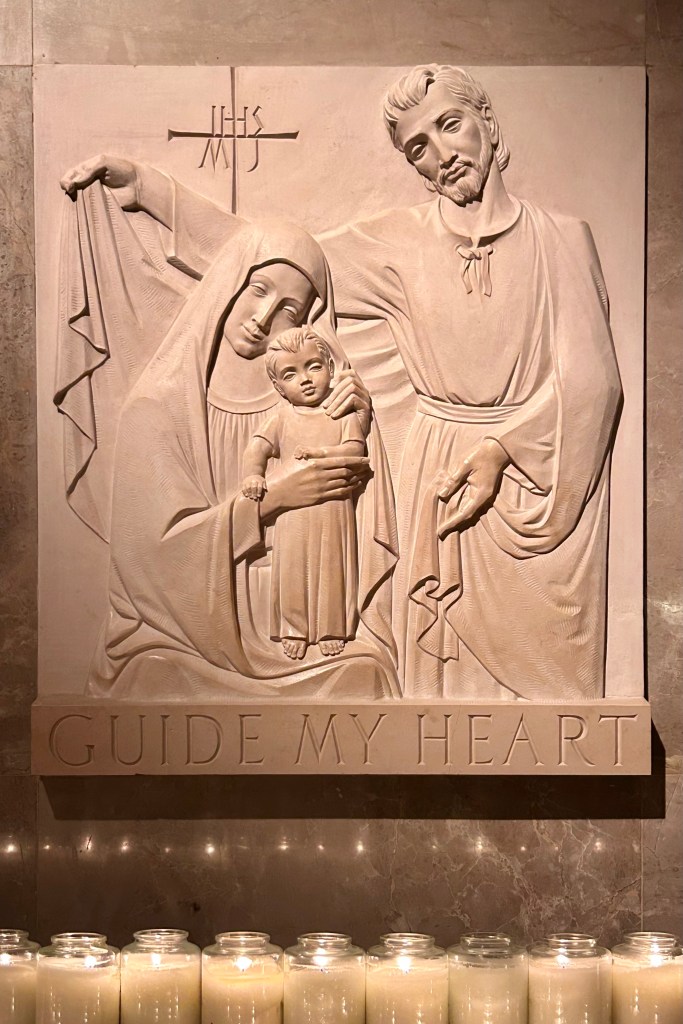
I sit with her for a while, and then prepare to light candles for my loved ones. I am drawn to a votive stand nearby. One area is all-dark; I decide to add light there. Kneeling, I observe that above the votives is inscribed in stone, “Guide my heart.”
Slowly I make my way upstairs to the vast upper church and find a seat for Mass in the front right wing, facing one of countless representations of Mary. Above us is written, “Never was it known that anyone who implored your help, O Most Gracious Virgin Mary, was left unaided.”
Bishop Checchio reminds us of the guiding words for this Holy Year: spes non confundit, as St Paul’s writes to the Romans, “Hope does not disappoint.”
*
A few days of retreat help to loosen my inner coil. On the last night, my erstwhile lover and I go out to dinner. Sitting side by side, we talk about our separate futures as we always do on our last night. So many last nights. So many tears already shed. And (we laugh) so many times we see each other again. Each a gift, each a healing—for both of us, in different ways.
We found each other at midlife when we needed to be loved and seen, forgiven and understood. By some angelic intervention and saintly intercession, we did. We do. We are.
We are pilgrims. We look for signs and for meaning. We try to listen for the Holy Spirit. We pray for guidance.
We realize we have to let go more, in order to make space for whatever comes next. It seems fitting that we are hours into: a new moon in Virgo, the new Judaic year 5786, and the autumnal equinox.
At long last, I begin to cry for everything that has arisen over the past week, for which I could not feel a thing.
“I always seem to be able to cry when I am with you,” I say, and he answers, “That is because you are safe here.” We go to sleep, and finally, I rest soundly.
The next morning, I drive him to work, say au revoir, and point my car north, toward home.
Tomorrow we will “beat on,” try harder, and keep believing we can find what we seek. It may have eluded us thus far, but “tomorrow we will run faster, stretch out our arms farther… And one fine morning—.”*
When I get home, I put my hands together in front of Mary and pray for all of us, everywhere.
*
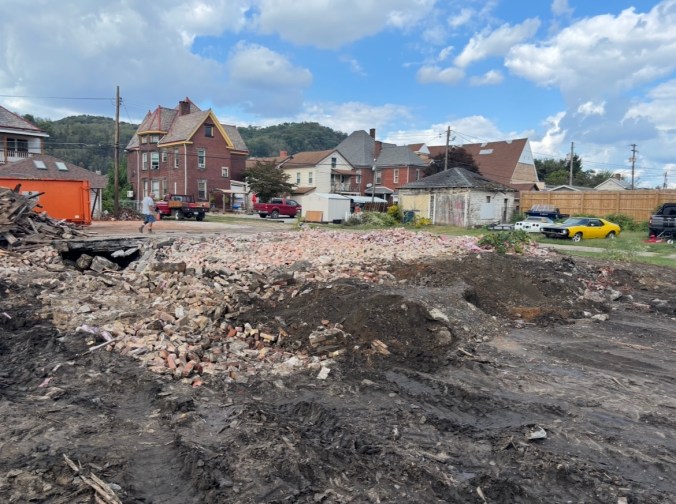
Epilogue: The following week, I receive photos of the remainder of the cleanup.
There is a full view of the Ohio River last visible from this site in 1920.
There is a blank canvas where there once was art.
And there is hope.
* F Scott Fitzgerald, The Great Gatsby
Please guide all our hearts.
Amen.
 Where I End & She Begins