“Those who sow in tears shall reap in rejoicing.”
– Psalm 126:5
For a number of years k-dramas entertained me at the close of day. Today, it’s the show Receivers, and the previous one, Quarterback. Both feature some of the best in the league. Quarterback is brainier than Receivers, which is more elation, more cheers, more extraordinary moments. There is some overlap, but not much. It’s interesting to screen Receivers first, in the opposite order of their release.
As I listen and watch, my delight fascinates me. Devante Adams (Raiders) says, “My benchmark isn’t wins and losses, it’s greatness.” Yes, it’s the greatness I am enjoying—the extraordinary plays and the overall excellence—but it’s also the little things.
Even though I’ve been rooting against Patrick Mahomes (Chiefs) for years, I can’t help being charmed hearing that he makes an effort to compliment the opposing team, even when they sack him. “Good job, dog,” he says—we hear it on his mic—and tells us, “I know they’re gonna hit me. I want them to be as nice as possible even though they have to do their job.”* With a dad as a major league baseball player, he planned to play baseball himself, and it is through these eyes that he sees the football field, accounting for many of his creative plays. Since this is such a rich trough, once a week the Kansas City coaches give the team time to develop their own plays. Mahomes reveals that he has to take notes on whatever he is studying and then transcribe them a second time to integrate them into memory. I relate to this.
Watching both shows, I develop increased respect for QBs. Peyton Manning, the executive producer, calls it the hardest job in professional sports. Kirk Cousins (Vikings) says it’s like studying for an exam, every single day. The plays they must memorize and execute on command are like 3D equations, tailored for each opponent.
I tell a few friends that I have a smile on my face almost the entire time I am watching Receivers, and it takes me a bit to figure out why.
The music of the football announcers’ voices, infused with suspense and elation. The play by play of America’s sport.
It’s the sound of my Dad being home.
Dad has not been home for thirty years. They say grief doesn’t go away, it just takes on different forms. It ebbs and flows. It can hurt just as much (sometimes even more) than in the very beginning, but then it can retreat to a faint star in the night sky.
The sound of football in my apartment these evenings makes me cry and smile and laugh at myself.
And feel some wacky sense of love.
*
Last weekend I went on an adventure. (I’m pulling a Mahomes here, reviewing all of my notes, rewriting them to share but also to integrate them more in my mind.)
Over the years of my newfound single-dom, I’ve taken a night away here and there to explore an area, to cherish my adulthood or to seize some prized freedom, often as a birthday present to myself. This year was different. I found a workshop at the Omega Institute by Lorna Byrne, an Irish mystic and author of Angels in my Hair, a book that made a difference in my life over a decade ago.
Learning about Lorna is one of those mystical moments in its own right. My former mother-in-law sent me Angels in my Hair. When it arrived, I read it in a sitting, reached out to her immediately, said an ebullient thank you, and she replied, “What book are you talking about? I never read it. I just saw it at the bookstore.”
Lorna Byrne herself is an interesting figure. A child born into poverty, she saw and spoke with angels from the beginning, leading her parents to believe that there was something wrong with her. Adding this to dyslexia and learning struggles, she never learned to read or write well; all of her authorship is done by dictation and transcription. She says God and the angels educated her. To this day she sees and speaks with them, not always taking their input on face value. Our workshop is punctuated with her “giving out to God,” as she says, which we learn is an Irish expression for expressing her frustration with Him. (Or with her struggles to translate out of the Elusive.)
Our beautiful classroom is on the perimeter of the institute, surrounded by old growth trees, just beyond the lake. The event begins on Friday evening.
*
The first thing Lorna says when she walks up to the dais in hand-knit socked feet is that she sees all of us with our guardian angels beside us; she sees them as physically as you and I (or rather, she sees all of us as translucent). One of her key messages is that we all have a guardian angel who loves us without condition and who connects us with our souls. Our soul, she says, is the “spark of light of God” held within each of us. Her next step is to describe what she sees, how each guardian angel manifests, next to a handful of people chosen at random.
Although I know and cherish her work, by bedtime I’m not sure I want to stay. I question what I will gain and consider cutting the weekend short. Perhaps I will leave on Saturday at the end of class. My single room—in a small dorm-like building with a public bathroom down the hall—is enough of a stretch for one night.
In the morning I will turn fifty-five.
*
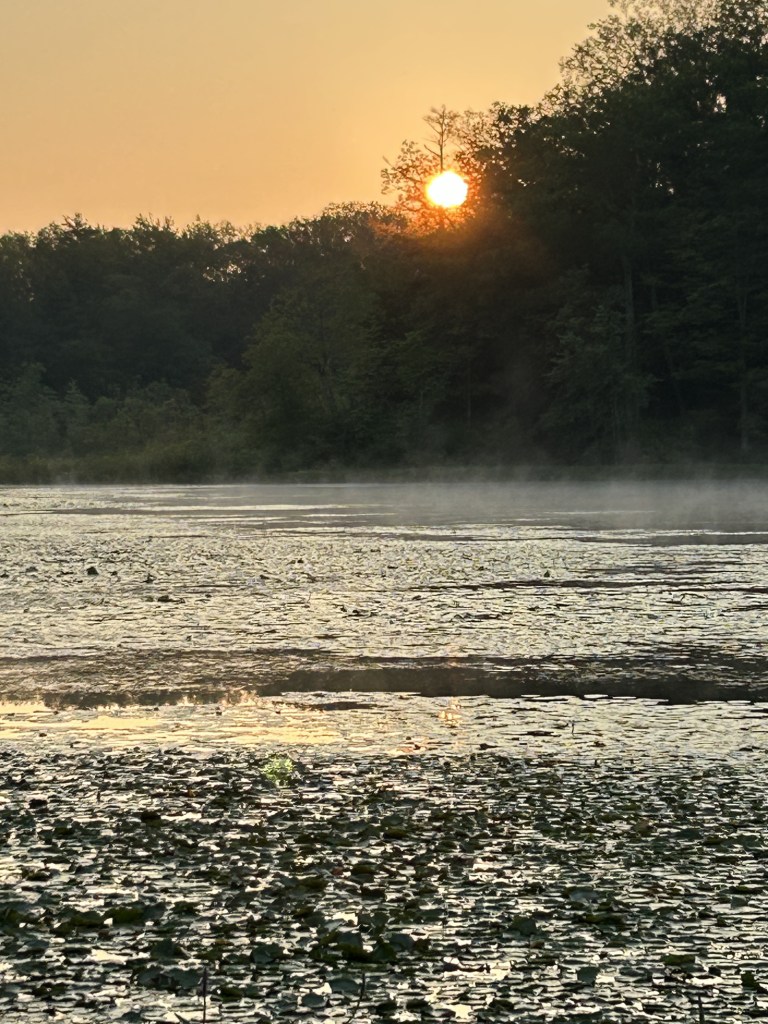
I wake at dawn and walk down the hill to watch the sun rise on the lake. This alone is worth the price of admission. I write in my notebook: We all want love, to be seen, heard and accepted unconditionally. To hold and be held. But do we do that for ourselves? Can we call ourselves beloved? Can we at least call ourselves a spark?
I also write: Old me—wanting to be with someone (anyone!) who loves me, and the price I will pay for that is? A Life.
Birthday messages arrive, which feel lovely.
I have decided to stay.
Soon it is time for breakfast. After reserving my seat for the workshop, I walk up the hill to the dining hall, and passing the entrance sign, I am provoked to reflect on the word Omega. The last, the end, the ultimate limit of a set. Large, great, mighty, extreme or final part. A few days ago I wrote in my notebook (after the death of someone else’s dad and plans to see my childhood hometown again in a few weeks): Is this just a total reset? So much loss and pain everywhere.
With my food and coffee in front of me, I research the word more and see that omega is also a personality type in someone’s universe, defined as: “romantic, passionate, tending to keep to themselves. The creative outsider, self-reliant, independent of groups. Driven and intelligent but not interested in competition or conforming. One who gets strength from being alone.”** All of this feels relevant.
Walking back down to the classroom in the trees, I open myself to the day. The first message Lorna shares is that we choose our trip—our lives—in the Sea of Souls, before conception. We chose our parents and the whole lot.
Looking back at my own life and then looking over to my children’s lives, a sense of quiet ease settles on me. Lorna invites us to reach out to our guardian angels for help, to take away some of the anxiety we carry, and to connect with our souls.
Take a little step back. Then take a little step forward.
Looking out at all of us, she reports seeing a stream of “Unemployed Angels” pour into our space. This is a euphemism she coined and I adopted the minute I read her book. She wrote that loads of angels are always floating around, at the ready. We only need to call.
She tells us that when she received this message long ago, apparently she wondered what to call this abundance of tap-able support. Her dad was unemployed, out looking for work. It fit.
Angels are everywhere, looking for work.
Just call.
Call in the Army.
*
Lorna asks us to raise our hands if we have lost someone important in our lives. “Some people don’t know grief,” she adds. “It’s like ice cold inside of you. Time makes no difference.” Our morning assignment is to write a letter either to our guardian angel or to someone we love who has died. The room goes quiet as we go to work. Then break. And then the day really begins.
A mix of people volunteer to read their letters; some people Lorna asks directly. The room is transfixed.
A twelve-year-old girl sitting next to me lost her father five years ago. During our first session she asked, “Is he here? Can I talk to him?” She shares her letter to her dad and then a letter to her brother, her Irish twin. Before moving on, Lorna asks the girl’s mother—sitting beside her—to speak, and we hear of her perspective, losing a stillborn son a few years before her husband.
Many people point out a monarch butterfly outside the window as she tells her story.
Across the room, Lorna calls on a young woman, late 20s or early 30s, dressed in a white sundress. She gets up reluctantly and speaks of her mother’s passing, “I feel so gypped” she reads aloud and comments, “She was so young. But I deserved it because I was a bad daughter. I was so selfish. She said so.” In her letter she asks her mother, “Why didn’t you hug me more?”
A man, probably in his 60s, says he feels like he never lived up to his parents’ hopes for him. A few seats away, young man’s voice breaks when he shares that his late mother’s accent sounded exactly like Lorna’s brogue; he speaks of how he struggles to be a good husband and father. And then a fifteen-year-old girl—who lost her kitten in an accident—apologizes in tears for her evident grief not being “real enough” compared with the others, before she reads her letter to Greg (the cat).
The room is flooded with grace, trust and compassion. Lorna engages deeply with each person; she seems to know when to encourage, too, “What else do ya have dere?” she laughs with her lilt.
A frail elderly couple near the back stand together, again reluctant but willing participants. “I don’t think I can read it,” the lady says; she starts, “Dear Mother, I miss you…” and she makes it through. Then pauses. There is a part two. “Dear Baby …” She stops. She cannot continue. Her husband finishes reading it, barely.
There are more. Seated behind me, a mother speaks of losing six babies before having her son who is now an addict. Across the room, a daughter—struggling with alcohol and her mental health—stands beside her mother who lost her second husband recently. “Do you get signs?” Lorna asks. “Yes.” The mother replies through tears. “A woodpecker.” And if you can believe it, we hear a woodpecker in the woods.
I am not one to have ready access to tears, but I am overcome. Over and over again. These are not my stories, yet I recognize mine in many.
A Sea of Souls. They picked me. I picked them. Long before.
*
Although a bit of a non-sequitor, I also want to share what she said to the twelve-year-old after comforting her—a bit of life advice: “As you grow up, you will be asked to do things and go places… Listen to your guardian angel. If it doesn’t feel right, don’t do it. Don’t go. Or if you want to leave somewhere say, ‘I have to go now. Does anyone want to come?’ Because often someone else in the group also wants to leave but they’re not brave enough to go alone.”
I’m not sure why that moved me as much as it did. Maybe I wish someone had spoken to my girl that way. (I recall how mine seemed so old at twelve, insistent she was older. This girl beside me said, “I’m still so young! I’m only twelve.” Part of my grief is right here.)
*
At lunch break I find myself emotionally exhausted. Often I reach grief through sudden acts like stubbing my toe; here I am being presented with catharsis in honest form. I find a table in the dining hall and sit down with three men, two in private conversation, the other about to leave. I expect to be left alone, but one comment about my cap and we are off to the races, talking of his workshop and mine, love and loss, hope and possibility and serendipity. (Of all the coincidences, he is ’73.) I feel surprisingly restored. This Omega is a special place.
Our afternoon assignment is a guided meditation to hand-deliver a message we want to give to God. My message is Luke 22:42. After some discussion and sharing, the workshop ends for the day.
I leave promptly to get to a local church for Vigil since Sunday will be busy. I also love the idea of going on my birthday. It feels right and just. Arriving just in time for the 5:30 service, I find two fully habited nuns awaiting Mass, but no priest. The doors are unlocked. We wait, but nothing happens. Eventually I decide to drive on to a small church about 20 minutes down the road with services at 6:15. “Oh, that’s far too far,” say the nuns who are leaving for the National Shrine early in the morning.
After church, I speak with my child, get serenaded on Facetime, order an amazing late-night tuna melt at the café, and call it a day. Fifty-five years are complete, and with a blessing and book signing the next day, so is the workshop.
*
Although I know it’s time to go, I hesitate to leave. I feel completely wiped out by the whole experience, and at the same time, I want to keep operating at this level of closeness. I don’t feel the need for the workshop to continue, nor to spend another night, nor to meet with more people. But I don’t want to change the channel. I fear the withdrawal; I don’t want to come up from the dive too fast.
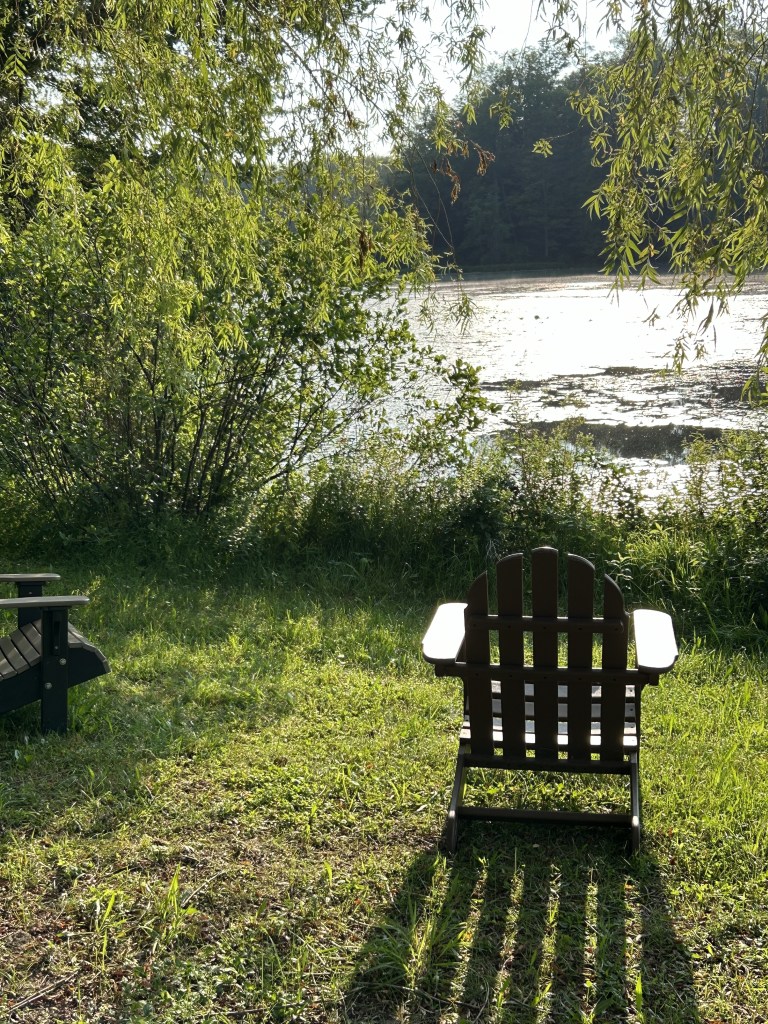
Since I’ve already packed my car, I walk to the dining hall for the last time, get some lunch and then find an Adirondack chair under a beautiful old tree. The weekend attendees gradually fade away, and the campus quiets.
I think of my vision from the guided meditation, of my littlest self jumping into the arms of my guardian angel—named for the one who honors God—and how they approach the Brightest of Lights. I recall feeling my own losses in the stories of many people. And I picture my son in communication with my guardian angel. My littlest self seems to be listening to my thoughts and knows about this connection already, rolling her eyes at me as if to say “adults are so blind.”
In Lorna’s words, “Why are you blind? Why can you not see? I give out to God about this all the time.”
Both mornings I wake at dawn and walk to see the sunrise. On Sunday, I climb up to the Sanctuary and pray all of the prayers I know in all of the faiths I’ve met and thank the path that saved my people. And then I thank the Path I am traveling.
“There are millions of names for God.”
Lorna speaks in simple sentences, not unlike my littlest self. She speaks with an effort to reach many faiths. One of the messages at the end of our workshop is, “At the last moment of life, you know everything—in a flash of light—you will be shocked and think ‘how could I have been so silly’.”
You don’t need big words. Prayer comes from every cell of your body. Adore each other. Manna from heaven. Tiny miracles, everywhere. Notice what is happening. Don’t reject anyone. Give with a pure heart. Never expect anything in return, not even a thank you.
Let yourselves shine with the spark of God’s light within you.
I wake each morning with hope. I open my eyes to the light. I work on my list. I always seem to create something. I always pray. Day passes into night and I do it all over again until the end set, until… omega.
*
After deep, rich, healing conversations with friends, I make it home. I unpack, do laundry, respond to mail, and then I’m ready to end the day joyfully. I have some scrapbooking to do with all of my new images, and I pull up my football show on Netflix. Again, my heart smiles in recognition. My dad is near. My home feels safe, and I sense the enormity of his love from this simple classic American soundtrack.
Everything is a little bit more whole than it was before I left. I see just a little bit more clearly. I am happy to be home, happier than when I left. I was able to unpack my grief and see it in the light of day, share it privately but in a public place.
“Life isn’t hard,” Lorna says, “we make it hard.” I’m not sure I agree with her on this, but I know that her workshop cleared the air, shook off the dust and made the dancing dust reveal already existing shafts of light.

* not exact quote but close
** Niall Stewart, “Alphas, Betas, Gammas, Omegas, Sigmas,” Modern Identities

 Where I End & She Begins