We are not idealized wild things.
We are imperfect mortal beings, aware of that mortality even as we push it away,
failed by our very complication,
so wired that when we mourn our losses we also mourn, for better or for worse, ourselves.
As we were. As we are no longer. As we will one day not be at all.
― Joan Didion
As day breaks, three quotes reach me. Mary Oliver: “sometimes I need only to stand wherever I am to be blessed.” Raymond Carver: “woke up this morning with a terrific urge to lie in bed all day and read… and gave over…put myself entirely in the keep of this rainy morning.” And Joan Didion: “life changes in the instant… the ordinary instant.”
Someone recently called me an empty nester and I said, no I am not. I am a bird in flight or poised to be in flight. My little bird did not leave the nest; I built her one and I flew from it. I now live in a rented nest, full of all my things now out of boxes. I have a home, at long last. My own nest that no one has left. I can and will fly to my girl, but thus far, she flies to me. These are early days still, of me belonging to myself. One day at a time, checking the weather conditions. I feel blessed to be as I am, standing right here.
This morning I realized, gloriously, that I am responsible to no one.
I have a routine: get up, run-walk, find a photograph, write anything that landed during the walk, send messages and start my day. For a while I have banked my days in anticipation of what may come, hours of conversational therapy or surprise needs or ongoing projects/appointments/work. Today I asked myself: what would I do if I didn’t follow my self-imposed discipline? I checked my messages, saw nothing on Instagram except Raymond Carver and thought of putting myself in the keep of this grey day.
Exactly one year ago I wrote a piece https://whereiendandshebegins.com/2022/01/17/in-service/ about going to DC for a party. It was the farthest I had driven from Ohio, to a city I did not know, with a Nor-Easter on the calendar two days hence. I went for the night.
One of the gifts of writing is the re-gifting of self to self. Embedded within this piece is hidden code that triggers memory of the specially curated music I played in my hotel room, the snazzy espresso machine, the strong hot shower, the delighted look of the valet when I took the car out in the dark to see the sunrise. All of that and more returns to me when I read it. It also foreshadows and reveals just how far I have traveled in these 365 days.
It starts by referencing Joan Didion. When she wrote, “life changes in an instant, an ordinary instant,” she was speaking of the life and death of her husband John Gregory Dunne ’54. But as we all know, life changes in an ordinary instant in lighter ways, too. Leaving that DC party, I took a few business cards, and when I got home I texted everyone to let them know I made it back safely.
After re-reading my blog post of a year ago, I dig out my journal from those days. My journals are messy, sometimes indecipherable. I write early and late, sometimes in the dark, sometimes not sober. I tell G to burn them when I die because they house pain I do not want her to see.
[Years ago I took Natalie Goldman’s suggestion in Writing the Bones to get cheap notebooks and write the dirt. Be not sacred or precious. Scribble out when necessary. Believe me I did. I do.]
While this journal does not mention the music or the shower, it does mention the view, and it has this—a surprise to find, written moments before checkout—which says it all, in less, but in its own kind of code:
DC in 24
The eye of the elephant
The play of the panda
The child in the adult
The open streets and luxury hotel
The glory of freedom
The beauty of the capital
The brutality of war
The question of ancestry
The arrow of persecution
The gift of privilege
The casualty of faith
The membership of belonging
The choice to believe
The choice to keep secrets
The choice to leave
The opportunity to celebrate
The honor of appointment
The notion of service
The notion of humanity
The pleasure of friendship
The delight of invitation
The treasure of connection
The chance to just be
The moment of yes
The pathway of yeses
The possibility of more
Life changes in an instant. An ordinary instant.
From my journal notes, I also see how G was in so much pain. She was on a bender, baking and copying recipes and breaking our HP ink account (HP doesn’t know how to handle our extreme scarcity and extreme demands.) She was crying in jags, sleeping and sweating in her sauna blanket. It snowed and I had to shovel it all.
After posting my blog I wrote in my journal this is how I connect. This too is how I survived.
*
Last weekend it was NYC, in the company of someone whose business card I received a year ago. We had an event on Friday night and plans for Saturday evening. Saturday afternoon, you pick, he said.
I have a favorite place in Alexandria, Virginia. It is where George Washington prayed: Christ Church. I visit as often as I can, and I pray there for my child, our country, our futures. It happens that Christ Church has a little gift shop, and one day I am given a silk scarf designed with the motif of a stained glass window. The window of the Cathedral Church of St John the Divine.
John Gregory Dunne was eulogized and interred at St John the Divine. So was Quintana Roo, their daughter. Eventually so was Joan herself, just a few months ago. My Saturday afternoon pick is to ride uptown to 111st Street at Amsterdam to the Cathedral.
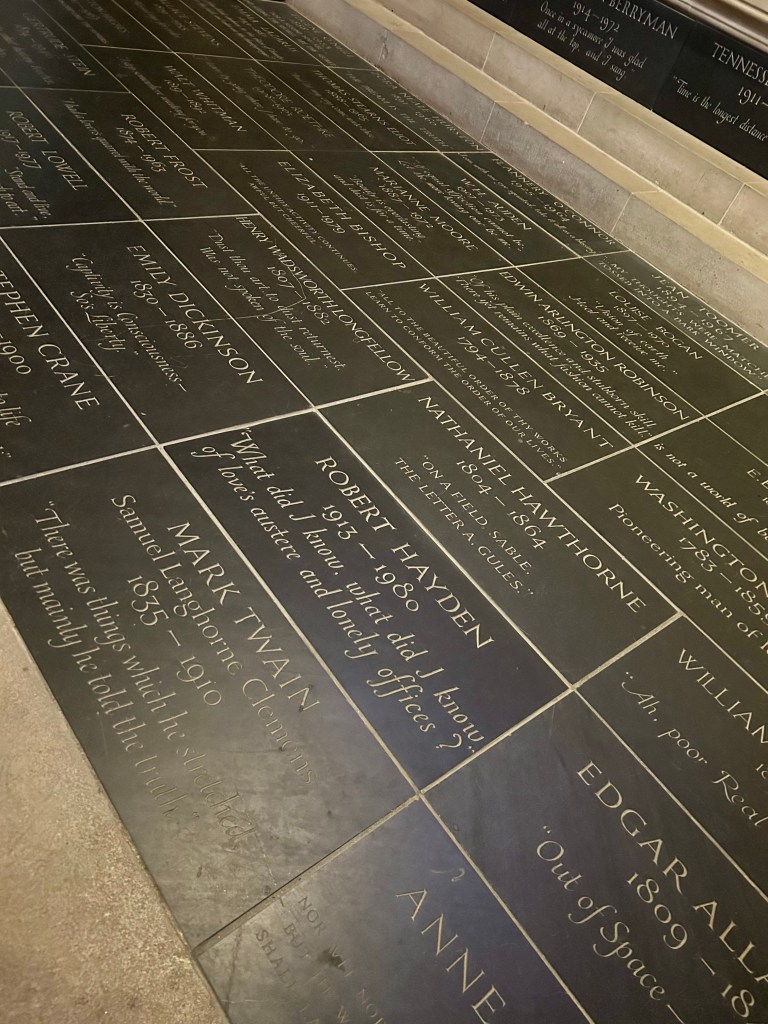
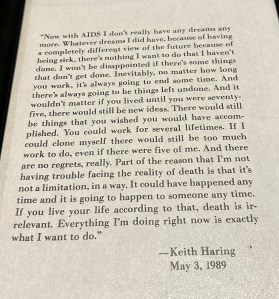
From the start, it startles. Its sheer size. The complexity of design—is it Roman or Gothic? (Answer: both.) The chapels within each vary dramatically in style; the overall experience feels as much cultural as spiritual. Poetry. Abstract sculpture. Service. Loss. Bravery. It is a place where Spirit and art and community find intersection. The scale of one person’s actions versus the whole of a family, city, nation. The window given by the Astors after their Titanic loss with the image of the ship in the lower right corner. The motherhood window dedicated by Queen Elizabeth II. Keith Haring’s last piece and his words, “death is irrelevant. Everything I am doing is exactly what I want to do.” There is more, so much more. The ceiling alone. The window.
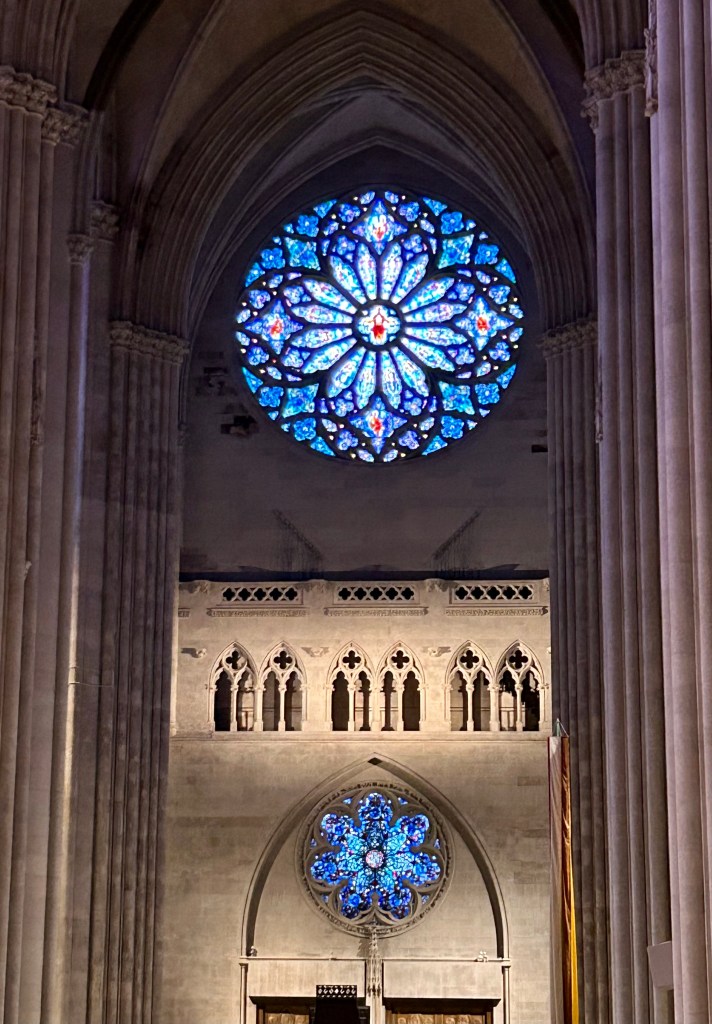
The Great Rose Window that drew me in the first place is four stories tall, 40 feet in diameter, the figure at the center is 5’7”. Its circumference is 125.5 feet—the same as the arches that seem to frame it.
Impossible to see in any detail from where we stand, I learn later that it is the fourth largest rose window in the world (after Chartres at 46 feet and the two at Notre-Dame, both 43 feet). Built in 1932, it depicts key figures from Old and New Testaments, from Jesus at center, to the writers of the four gospels at the cardinal points (St John the northernmost), to Jeremiah, Ezekiel, Daniel and Isaiah at the intercardinal points, to winged figures with trumpets and thuribles, to seraphim representing divine love and cherubim, divine wisdom. Apparently the window seeks to represent the Bible itself, yet with light shining through 10,000 pieces of glass 75 feet above our heads, we only see the whole, the kaleidoscopic array, the effect of the creation. Which is perhaps something to ponder in its own right.
We walk into the many individual chapels, eventually finding the one where the Didion/Dunne family is laid to rest. My eyes sting. The Year of Magical Thinking floods back as does detailed memory of what I wrote a year prior. How John wrote on the question of service and how he complimented Joan on a sentence she wrote. Minor moments that still reach my heart. The life of two writers and their daughter who got sick and died while Joan was grieving her husband. The stuff of nightmares.
We find a place to count our blessings, as my mother would say.
I need only to stand wherever I am.
In prayer I speak of healing and addiction, of gratitude, of wisdom and love, of this anniversary from brave travels to an embodied life belonging more to myself than perhaps I ever have, living on my own for the first time since college (if you can call college living on my own).
And then I pray for John, Joan and Quintana—strangers but not strangers—with a depth of feeling that I cannot fully explain:
To those who write to us of their lives, of what they see and experience, so that we may see doubly, through our eyes and theirs. To those who lose or have lost their family, their lovers, their children—and somehow breathe on. To our imperfect mortality—our past selves shadowing us today that we mourn—and our future selves lighting the way.
Eventually we walk out, paying tribute again and again to the Great Rose Window, agreeing that we have become enamored with this Cathedral’s beauty and complexity, somehow representing all that America is as a nation, all that New York is as a city, and all that we are as humans in our very complication.
*
Often it is writing and other writers’ work that guide me onward. This morning it happened to be slivers of Carver, Oliver and Didion that led me to my notebook, to my computer and to this piece. Like finding pennies on the sidewalk, their words provide moments of recognition that reverberate in my soul, delivering a whisper of divine wisdom, love and compassion—mixed with sheer humanity.
Increasingly I wish to put myself in the keep of this whisper.
Before we leave St John the Divine we light candles, praying our fraught world will be kept, too.
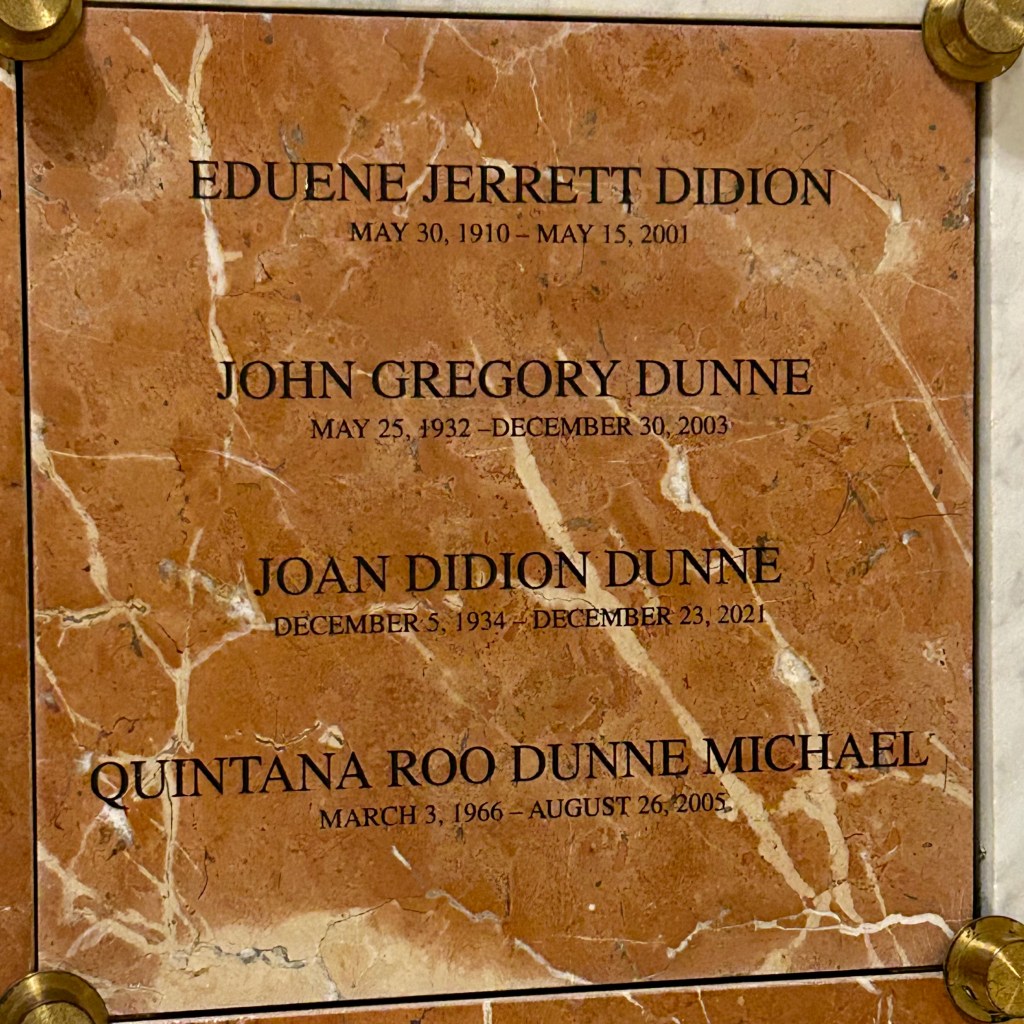
- Eduene Jerrett Didion is Joan’s mother. It has been noted that she gave her daughter a notebook when she was young, to learn how to express her feelings.
 Where I End & She Begins