The sun shines not on us, but in us.
The rivers flow not past, but through us.
– John Muir
Rivers are roads which move.
– Blaise Pascal
Over the past year we have been living in a small, closely knit community in eastern Ohio. Its tight-knittedness is partly because of its size and partly because of an ongoing shared history of loss. Standing defiant against further change, it holds firmly to what it can. “River Rats” some outsiders call them, but within the village there is a deep running strength and ingenuity I have noted from the beginning. Everyone knows how to fix things, albeit with differing levels of endurance.
I walk the largest cemetery with a friend. She tells stories and calls out last names that even I recognize, many of them Italian, many with kin still among us. There is value in this name recognition, these pillars of community who stood decades ago, proud to be a part of this town. I comment that it is a bit like caramelizing—the rich sweet savoryness that comes from being reduced—their ongoing affection for these names.
Not the typical dilution of history by growth and development native to most of the places I have lived.
I think to myself: under these circumstances, my dad’s and his brother’s names would be remembered in our Sonoma County hometown as would other people who were a part of the original development of Santa Rosa, many of them Italian, too. If there were such a distilling and reduction, many familiar names would continue to be spoken. But instead my hometown did the exact reverse of here, pricing out many of its people, losing its memory and its respect for the elders who helped build it.
Here, there is still effort made among what remains of these families to hold up their honor and the honor of the past. Somehow I have become a part of this attempt toward rejuvenation, and our effort is part of my desire to understand.
*
On the other side of the village from this cemetery is the river, and along the river I seek greater knowledge. We watch countless barges go up and downstream with giant multinational corporations’ names emblazoned on some. I learn that the average barge tow—which looks like a few floating football fields, hauls the amount of 1,050 semi-trucks—moving cargo about 75% more efficiently than by truck [in terms of fuel and carbon dioxide emissions], 15-30% more efficiently than by rail.*
Less than a mile south of us along the river’s edge is the intermodal facility owned and leased by the Columbiana County Port Authority. Part of Foreign Trade Zone #181 [a benefit to many, servicing ten counties] and a Federal Opportunity Zone [an available incentive as yet un-tapped in this county to my knowledge]**, it is tri-modal: where river, rail and road meet. Products from all over the world arrive for distribution to the greater Cleveland/Pittsburgh region which is distinct for being like the hub of a wheel, proximal to many of our country’s largest markets: Atlanta, Chicago, New York, and the Philadelphia-Baltimore-Washington DC corridor.
A few weeks ago, we were invited to tour one of several terminals along the river where commodities arrive like soybeans from India, huge metal coils from Brazil, barite from Pakistan. Up-river the facility next door (still in the village) takes in coal, steel, coke and fertilizer. Molasses also arrives from Louisiana, an essential ingredient for liquid livestock feed supplements. Each dock competes for deliverables.
We watch steel coils being off-loaded from a barge with a Mantsinen 120 Hybrilift/60 ton overhead crane that can unload 800 tons of bulk material in an hour. Installed in 2016. Cost: $5.1 million.
It is possible to ship an item from China to our doorstep in less than three months: approximately two months from the mainland to New Orleans via the Panama Canal, and three weeks from the Mississippi River to the Ohio River to Wellsville.
In the reverse direction, NASA’s Glenn Research Center in Cleveland has sent rocket parts to the Kennedy Space Center through Wellsville via the Ohio, the Mississippi and the Gulf of Mexico to Port Canaveral, Florida using the same crane we saw in action.
Marathon Petroleum also sends product—oil from the Utica shale and asphalt from their refinery in Canton—back down-river, first by truck to the terminal where it is stored and then loaded on to barges bound for a Kentucky refinery.
Next-door down-river within the same facility, we see barite in various stages of production. It will be used primarily for drilling but also for use in plastics, paints and other products. I was heartened to hear the manager note that most of his twenty-odd employees are local to the village, and he uses businesses within the county for supplies and improvements whenever possible.
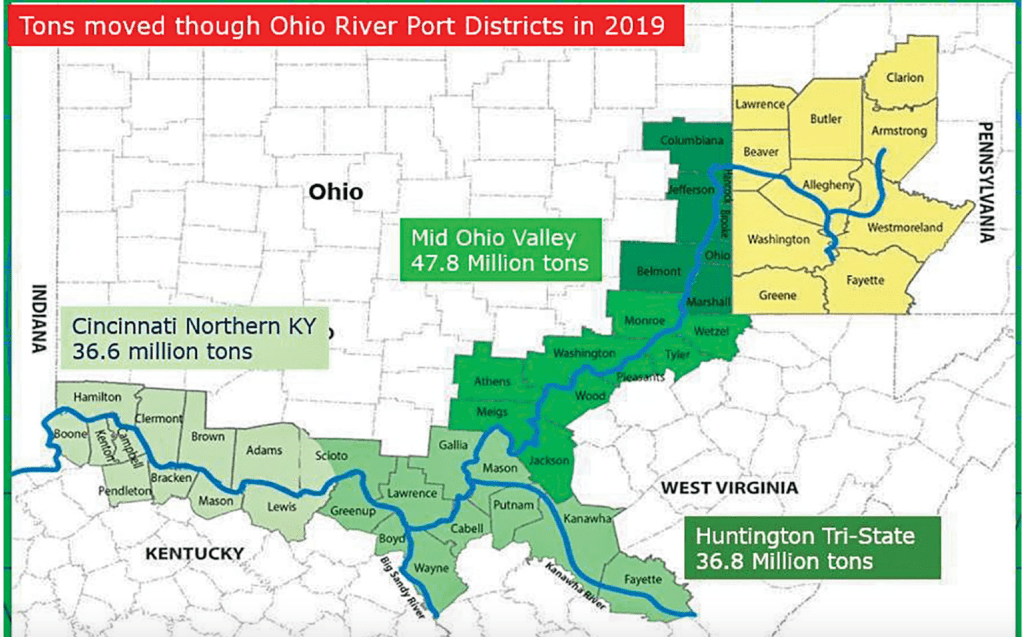
During our presentation it is announced that the area recently received designation by the Army Corps of Engineers as the Mid-Ohio Valley [Statistical] Port District. Comprised of 220 miles along both sides of riverfront from mile marker 40 – 256.8, this “statistical” port allows for the tonnage, value and economic importance of the region to be measured. Nothing really changes, it just is now getting counted, and it’s no small amount [see map below].*** This will help the Port Authority and others lobby and obtain grants supporting riverfront businesses in the region.
While this clearly is all brand new for me, it’s interesting that this tour is brand new information for most of the locals, too, including some regional dignitaries, non-profit groups and a cadre of elementary school teachers.
I never even knew this was here, I hear on repeat.
In a town that knows its historical families so well, I find it interesting that significant swaths of the area are unknown to people who have lived here their entire lives. Relative to the size and struggle within the village, the numbers are quite stunning. 45 acres of active industry. Right here.
Global trade. Right here where people’s roofs are caving in. Literally. Where people walk away from their bills because they simply have no way to pay them and no way to get out of their real estate.
Global trade right here. Because here is where these multinationals receive handsome tax benefits. Otherwise they would go somewhere else, right? But how many rivers are there?
Something about this sits funny with me. Like the story that it costs a billionaire too much time to pick up a Ben Franklin that falls from his wallet. There is so much this community could do with a few of them.
I will admit my quiet obsession with wondering how the village can capture a few pennies of this wealth, translate them into local incentives, and once a model is built, apply it to the manifold small-towns in America that are suffering. How do we get them counted? I have one foot on land and one foot in a river of dreaming.
*
Meanwhile, on Main Street…
When G was taking down the house next door to the convent, an elderly woman drove by after dark. Smoking a cigarette, with the distinct sunken facial structure indicative of tooth loss, she pulled up in a small rusted-out pickup and asked if she could have the bent metal railing on the front porch. G said alright but come back tomorrow.
She did. With a helper who loaded all of the metal he could into the truck bed.
Is she going to scrap this or reuse it? I asked. He smiled with a bit of mischief in his eye.
Dinner? Rent? Something more nefarious?
Everyone says the price of scrap is up.
*
Unbeknownst to them, we have been collecting metals for months behind the church. G plans to keep some, but as soon as she got the old furnace and water heater out of the basement, we loaded the trailer and headed to the closest scrap yard ourselves. Our first load was the biggest and yielded the most.
Her next demo job involved taking down a fire-damaged house with aluminum siding. Although she only got paid for the base price of the dumpster, she made even thanks to the scrap, especially since aluminum pays more. But it has to be clean.
When we scrapped one of the stainless steel shelves from the side of the altar, it had screws attached. Take it home and take the screws off, one of the guys said.
What’s the price difference?
I don’t know, probably about 25 cents.
Go ahead and take it dirty today.
I go home and tell G to take the screws off the next one.
At the lower part of the yard a giant crane lifts things out of the back of your truck or trailer like child’s play. I have seen it take full sized cars the same way. One bite: washer and dryer side by side. The rest we unload by hand.
*
Any aluminum in that load? the boss at the front gate asks. You did it wrong yesterday. You need a lie detector.
As the trailer gets weighed, I wait in his anteroom and can’t avoid the bumper stickers: Liberalism is a mental illness. Beware Pelosi. NRA Member. A yellowing newspaper page on birtherism. While this kind of thing still makes me feel uncomfortable, nothing about it is new or shocking to me now. It just is.
I reply: I didn’t mean to lie–I don’t know how to tell the difference between all of the metals.
He comes back with a key chain and hands it to me.
If it works, it’s steel; if it doesn’t, it’s aluminum. It’s a magnet.
Pause.
It’s a lie detector. See?
He laughs, but kindly.
I am, somehow, in the club.
I start to get it. Aluminum goes across the street to the right; stainless steel across the street to the left. Dirty separated from clean. Every time you drop off something, you get weighed again. Everything else goes to the lower lot. Some people drop everything there.
I get a lot of respect for accurately reversing the trailer in fairly tight quarters. This makes me feel inordinately proud.
Each time I bring a load everyone becomes friendlier. I am one of two women they ever see. They comment on my loads, on the fire damage. A guy tells me two of his houses burnt down. One was probably my ex-wife, now that I think about it. I’m not going to own another house. Not worth it.
Another time he helps me unload, and at the bottom of the trailer he picks up a star-fold piece of origami. A missed bit of garbage from the job, I hadn’t seen it. Don’t see these much anymore. I’m going to take it home and show my grandkid how to make it. (I will admit to you, I thought to myself: this skinny, partly-broken guy, covered in grime, grease and tattoos, whose teeth are present yet destroyed, and whose eyes speak of many wars, knows Japanese paper folding?)
It is midsummer. It is hot. But they maintain their good humor most of the time, at least with me. It’s cooler in hell, one of my favorite guys says. We laugh. In the pit with the crane and metal reflecting heat everywhere, no shade to be found, he may be right.
Hey Scrappy, says the boss. He’s the final nut to crack. Groaning about people who can’t reverse their own trailers, he says he’s been doing it since he was eleven, almost fifty years ago. And then he tells me his birthday. Ten days after mine. We laugh.
I drive away, a few twenties richer, and I feel good. Every single person there is kind to me.
Something big and deep shifts within me.
This is how I start to know: I can live anywhere. I can find goodness in people everywhere. Even if we may not believe the same things or protect the same rights or even define our rights the same way. This, too, is our right in this wild crazy brave precious American dream that we share.
And my heart feels kind of fizzy with gratitude, just knowing this.


Below: Mid Ohio Valley Port District defined. Source: https://www.waterwaysjournal.net/2021/06/18/mid-ohio-river-statistical-port-district-okd/
h/t to Billy Joel’s “River of Dreams” and Mary Oliver’s “wild precious life” – neither of which I intended to quote, but I certainly thought of both of them when I came close.
* Columbiana Port Authority site http://www.ccpa-ohioriver.com/about/index.html
*** https://www.waterwaysjournal.net/2021/06/18/mid-ohio-river-statistical-port-district-okd/
There is also a relevant article in the Youngstown Business Journal: businessjournaldaily.com/ohio-river-feeds-businesses-across-country/
** For those interested in Opportunity Zones, 92% of all Ohio OZ funds have gone to struggling neighborhoods in counties that house Cleveland, Cincinnati and Columbus. Check out: eig.org/news/a-first-of-its-kind-exploration-of-ohios-opportunity-zone-investments
 Where I End & She Begins
Thank you for sharing your multi-dimensional adventure.
My favorite line:
“This is how I start to know: I can live anywhere. I can find goodness in people everywhere. Even if we may not believe the same things or protect the same rights or even define our rights the same way. This, too, is our right in this wild crazy brave precious American dream that we share.”
CHERYL L. BUNDY 917.301.7279 – mobile 203.801.3402 – work cherylbundy@me.com cbundy@silverhillhospital.org
>
LikeLiked by 1 person
Thank you! xo
LikeLike
Oh, you are such a keen observer! Wonderful, informative, and moving installment.
LikeLike
Thank you for reading! xox
LikeLike